

What You Need to Know About Microsoft Stock Performance Today
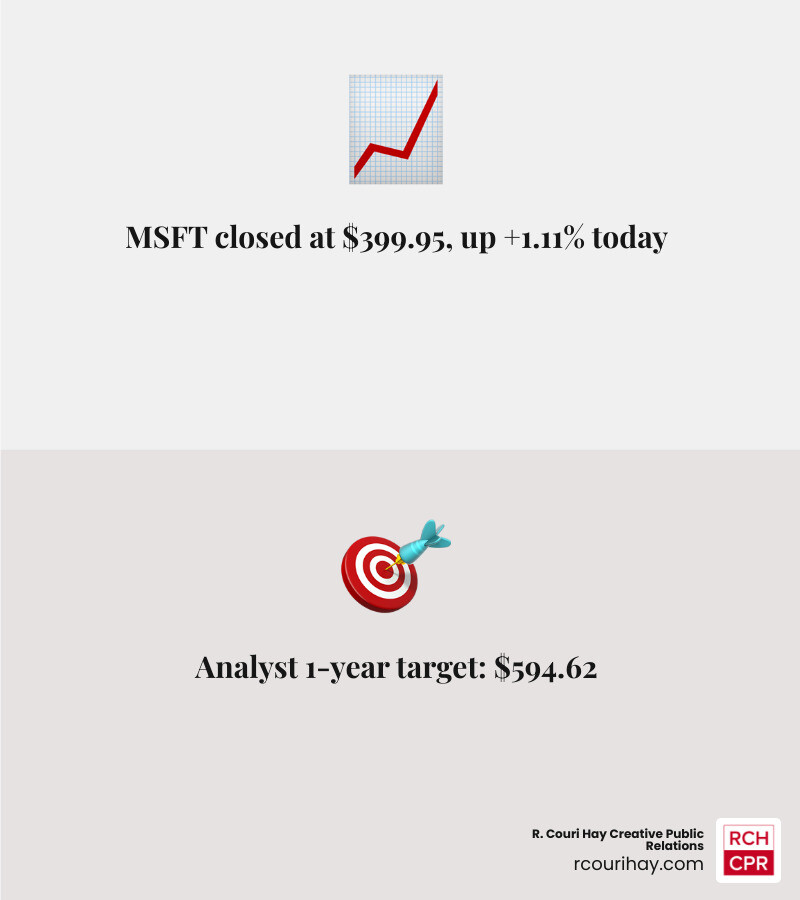
Microsoft stock performance today closed at $399.95, up +1.11% on the session — here’s a quick snapshot for investors tracking MSFT right now:
| Metric | Value |
|---|---|
| Closing Price | $399.95 |
| Daily Change | +$4.40 (+1.11%) |
| Intraday Range | $397.75 – $404.40 |
| Trading Volume | ~27.6M shares |
| After-Hours Price | $399.75 (-0.05%) |
| 52-Week Range | $344.79 – $555.45 |
| YTD Performance | -17.43% |
| Analyst 1-Year Target | $594.62 |
The story behind today’s numbers is bigger than a single session.
Microsoft sits at roughly $2.97 trillion in market cap — one of the most valuable companies on Earth. Yet its stock is trading nearly 28% below its all-time high of $555.45, hit just last July. That gap tells you something important about where investor confidence stands right now.
The key question isn’t just what MSFT did today. It’s whether today’s modest gain signals a real recovery — or just noise.
Five things are driving that answer: intraday data, AI strategy shifts, core financials, peer comparisons, and what analysts actually expect next.
Analyzing Microsoft Stock Performance Today: Key Market Data
When we look at microsoft stock performance today, we see a company that is fighting to regain its footing after a volatile start to the year. The closing price of $399.95 represents a resilient push upward, especially considering the stock dipped as low as $397.75 during the session. This “green” finish is a welcome sight for those of us who have watched the tech sector face significant headwinds recently.
The trading volume today reached approximately 27.6 million shares according to Yahoo Finance data, though some exchanges reported lower figures near 15.3 million. Regardless of the specific exchange count, the volume remained slightly below the 30-day average of 34 million shares. This suggests that while the price moved up, it did so without the massive institutional “buying frenzy” that usually accompanies a major trend reversal.

Comparing today’s intraday range ($397.75 – $404.40) with the 52-week high of $555.45 reveals a stark reality: Microsoft is currently in a correction phase. However, for the long-term investor, seeing the price hover near the $400 psychological resistance level is a sign of stabilization. You can track these movements in depth via the Real-time MSFT price and history page.
Intraday Volatility and Microsoft Stock Performance Today
The “vibe” of the market today was one of cautious optimism. Mid-day, the stock was actually trading down slightly at $398.85, showing a -0.28% dip at one point. This intraday volatility is often driven by “macro” fears—things like oil prices and geopolitical tensions—rather than Microsoft’s own business strength.
After-hours trading showed a minor slip to $399.75 (-0.05%), indicating that investors are essentially “parking” their capital and waiting for the next big catalyst. Sentiment remains mixed; while the “Magnificent Seven” generally traded higher today, there is a clear sense that the market wants to see more “proof” of AI revenue before pushing MSFT back toward its $500+ glory days.
Long-term Outlook vs. Microsoft Stock Performance Today
If we zoom out from microsoft stock performance today, the Year-to-Date (YTD) return of -17.43% looks a bit grim. However, context is everything. The 1-year return is still positive at +5.31%, and the stock is trading comfortably above its 52-week low of $344.79.
What really catches our eye is the analyst 1-year target estimate. The average forecast sits at a whopping $594.62, with some analysts even aiming as high as $730. This suggests that the professionals believe the stock is currently undervalued by nearly 50%. When the market price is $399 but the experts are looking at $594, it creates a “valuation gap” that usually resolves in favor of the patient investor.
The Copilot Pivot and AI Infrastructure Developments
Microsoft isn’t just a software company anymore; it’s an AI infrastructure titan. Recent developments suggest the company is reorganizing its “Copilot” teams to unify the experience across commercial and consumer versions. This move, led by Jacob Andreou, aims to reduce “adoption friction”—the fancy term for when users find new tech too confusing to use daily.
We are also seeing a major shift in leadership. Mustafa Suleyman, a key figure in Microsoft’s AI push, is reportedly shifting focus toward “Superintelligence” and model work. This internal “rejigging” is intended to keep Microsoft ahead of the curve as OpenAI (Microsoft’s close partner) begins to diversify its own cloud usage.
Recent reports indicate that Amazon is investing $50 billion in OpenAI, with OpenAI committing to use some AWS compute power. While some bears might see this as a threat to Microsoft’s exclusive grip on OpenAI, the reality is that Azure remains the primary backbone for OpenAI’s API services. Microsoft is also expanding its own hardware reach, securing a massive 1.35 GW deal for NVIDIA Vera Rubin GPU capacity through NSCALE, set for 2027. You can find more details on these strategic moves at the Microsoft Investor Relations updates portal.
Essential Financial Metrics for MSFT Investors
To understand microsoft stock performance today, you have to look at the “engine” under the hood. Microsoft’s financial health is, in a word, robust.
- Market Cap: $2.97 Trillion.
- P/E Ratio (TTM): 25.03. This is actually quite reasonable for a high-growth tech stock; for comparison, it hasn’t been this “cheap” relative to earnings in nearly a decade.
- EPS (TTM): $15.98.
- Dividend Yield: 0.92%. While not a “dividend play” in the traditional sense, Microsoft consistently returns value to shareholders.
- Net Profit Margin: A staggering 39.04%.
The “Intelligent Cloud” segment continues to be the primary driver of growth, with Azure revenue being the metric that most institutional investors watch like hawks. With a forward P/E of 20.70 and a PEG ratio of 1.29, the stock is priced for growth that is supported by actual earnings, not just hype.
External Market Pressures and Peer Comparison
Microsoft does not trade in a vacuum. Microsoft stock performance today was influenced by a “collision” of tech gains and macro worries. While the Nasdaq was generally buoyed by positive news from peers like Oracle (which saw an AI boom), external pressures like surging oil prices and the ongoing Iran conflict created a “drag” on the broader S&P 500.
In the peer group, Microsoft is faring better than some but lagging behind others:
- Nvidia (NVDA): Continues to lead the AI hardware charge.
- Oracle (ORCL): Jumps on strong earnings and AI demand.
- Google (GOOGL): Facing its own set of regulatory and AI hurdles.
Cybersecurity has also become a major theme. A recent cyberattack on medical giant Stryker, potentially linked to Iran, involved the misuse of Microsoft’s Intune tool. While this isn’t a “fault” in Microsoft’s software, it highlights the legal and reputational risks the company faces as its tools become the global standard. On a lighter note, the company recently released a fix for Windows C: drive access issues on Samsung PCs, proving that they are still handling the “small stuff” while building the future of AI.
Frequently Asked Questions about Microsoft Stock
Is Microsoft stock a buy at current levels?
Many analysts believe so. With 92% of 60 analysts giving it a “Buy” recommendation and the stock trading nearly $150 below its average price target, the consensus is that this correction represents a buying opportunity for long-term holders.
What is the average analyst price target for MSFT?
The average 1-year target estimate is $594.62. This suggests significant upside from the current $399 price point.
When is the next Microsoft earnings report?
Microsoft is estimated to release its next quarterly earnings report on April 28, 2026. This will be a critical date for investors to see if AI “pilots” are turning into paid contracts.
Conclusion
At R. Couri Hay Creative Public Relations, we believe that success is built on a foundation of long-term vision and impeccable execution. Microsoft’s journey mirrors this philosophy. While microsoft stock performance today shows a company navigating a complex global landscape, the underlying metrics point toward a future of continued dominance.
Whether you are managing a luxury lifestyle or a high-net-worth portfolio, understanding the shift from “AI hype” to “AI execution” is vital. Microsoft is currently the “must-execute” leader of the pack. As the company continues to unify its Copilot strategy and expand its data center footprint, it remains a cornerstone of the modern technological era. For those looking to dive deeper into their own holdings, you can find More info on Microsoft investor services directly from the source.
We will continue to watch the markets from our offices in New York, Palm Beach, and London, bringing you the stories of wealth and success that define our world. Microsoft isn’t just a stock; it’s a testament to what happens when innovation meets scale.