


What You Need to Know About Amazon Stock Right Now

Amazon stock (NASDAQ: AMZN) is one of the most closely watched equities in the world — and for good reason.
Here’s a quick snapshot as of May 2026:
| Metric | Value |
|---|---|
| Stock Price | $268.26 |
| Market Cap | $2.85 trillion |
| 1-Year Return | +45.46% |
| P/E Ratio | 31.68 |
| EPS (TTM) | $8.37 |
| Revenue (TTM) | $742.78 billion |
| Net Income (TTM) | $90.8 billion |
| 52-Week Range | $183.85 – $273.88 |
| Analyst Buy Rating | 96% of 71 analysts |
| 1-Year Price Target | $311.70 |
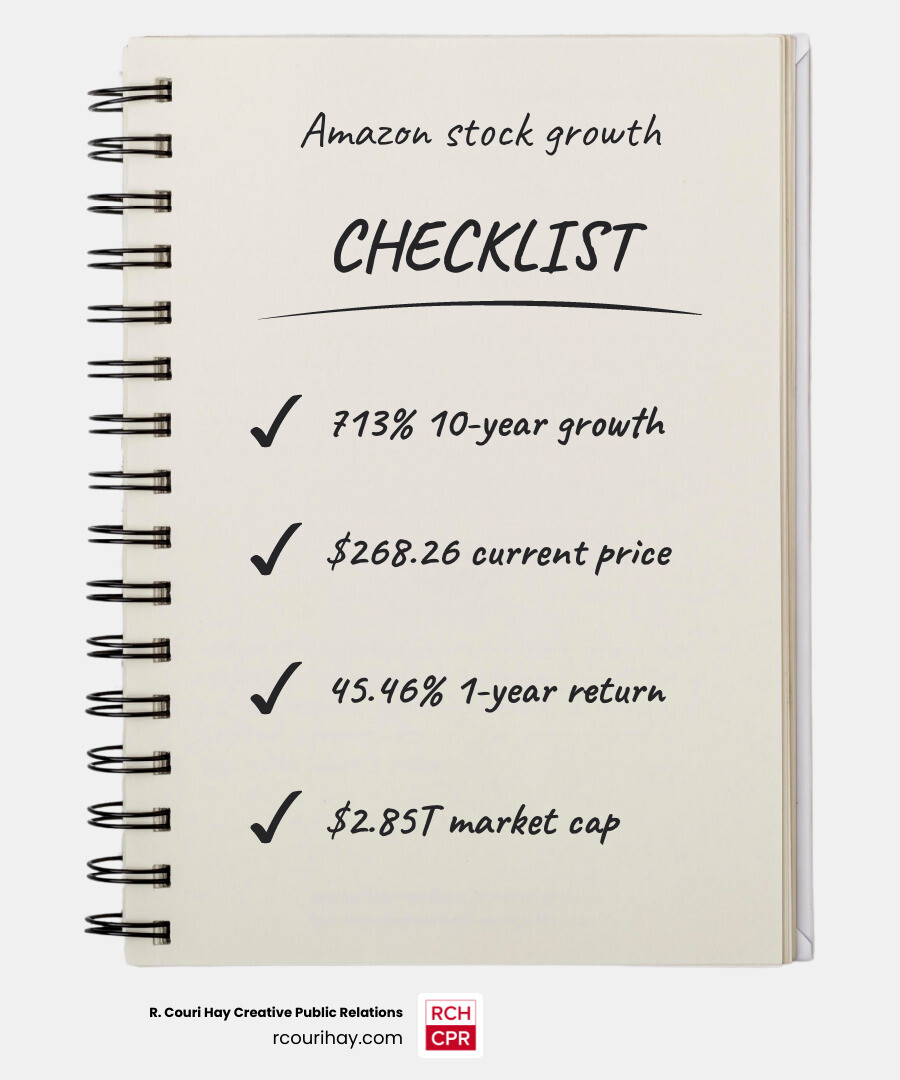
Amazon has grown from an online bookstore founded in 1994 into a $2.85 trillion technology and e-commerce giant. Its stock reflects that scale — up over 713% in the past decade alone.
Whether you’re tracking daily price movements, evaluating long-term growth potential, or sizing up analyst sentiment, AMZN remains a cornerstone holding for many serious investors. This guide breaks down everything that matters — from core financial metrics to competitive risks and what analysts expect next.
Current Performance of Amazon Stock in 2026
As we navigate through May 2026, the performance of amazon stock continues to command the attention of the global financial community. We are currently seeing the stock trade at approximately $268.26, reflecting a steady upward momentum with a 1.21% gain as of the start of the month. This price point sits comfortably within its 52-week range of $183.85 to $273.88, suggesting that while the stock has seen significant growth, it remains resilient even during periods of broader market volatility.
One of the most striking figures for us to consider is the 1-year return. Over the past twelve months, amazon stock has surged by 45.46%. When you compare this to the 10-year performance of 713.40%, it becomes clear that Amazon isn’t just a legacy tech giant; it is a high-octane growth engine that hasn’t lost its spark. The trading volume remains robust, with an average daily volume exceeding 46 million shares, ensuring high liquidity for both institutional and retail investors.
To get a real-time sense of how the market is reacting to daily news, many of our clients monitor the Amazon.com Inc (AMZN) Stock Price & News – Google Finance page. Currently, the NASDAQ:AMZN ticker is showing a Year-To-Date (YTD) performance of roughly 16.22%, proving that the momentum from 2025 has carried over effectively into the current fiscal year.

Key Financial Metrics and Core Business Segments
To truly understand why amazon stock carries a market capitalization of $2.85 trillion, we have to look under the hood at the financial machinery driving these numbers. Amazon is no longer just a “store”; it is a diversified conglomerate with a balance sheet that would make most nations envious.
With a trailing twelve-month (TTM) revenue of $742.78 billion and a net income of $90.8 billion, the company’s profitability has reached new heights. The Price-to-Earnings (P/E) ratio currently stands at 31.68. While some might view this as “premium” pricing, it is actually quite competitive when compared to the company’s historical averages and its peers in the high-growth technology sector. The Earnings Per Share (EPS) of $8.37 reflects a company that has successfully transitioned from prioritizing raw growth to delivering significant value to its 10.8 billion shares outstanding.
Investors looking for a deep dive into historical quotes and technical data often reference the Amazon.com, Inc. Common Stock (AMZN) Stock Price, Quote, News & History | Nasdaq portal. What they find is a profit margin of 12.22%, a figure that has been bolstered by the high-margin nature of Amazon’s newer business ventures.

Analyzing the Growth of Amazon Stock Segments
The secret to Amazon’s enduring success lies in its three-pillar segment structure:
- Amazon Web Services (AWS): This is the crown jewel. As the global leader in cloud computing, AWS provides the backbone for much of the modern internet. In Q1 FY26 alone, AWS continued to drive a disproportionate share of the company’s operating income. Its role in the AI revolution—providing the compute power for large language models—is a primary driver for the recent surge in amazon stock.
- North America Retail: This segment remains the bread and butter of the consumer experience. Beyond just shipping packages, this includes the massive advertising services business, which has become a multi-billion dollar juggernaut in its own right.
- International Retail: While historically a lower-margin segment due to heavy expansion costs, the international arm is seeing improved efficiencies in 2026. Prime membership growth in emerging markets continues to provide a steady stream of subscription revenue.
Analyst Ratings and Future Outlook for Amazon Stock
If you’re wondering what the “smart money” thinks, the consensus is overwhelmingly bullish. Out of 71 analysts currently covering the company, a staggering 96% maintain a “Buy” rating. This level of agreement is rare for a company of this size, signaling deep confidence in the management’s ability to navigate the 2026 economic landscape.
The latest reports from Amazon.com, Inc. (AMZN) Stock Price, News, Quote & History highlight that the Q1 FY26 revenue of $181.52 billion actually beat most street estimates. This “earnings surprise” culture has helped maintain the stock’s momentum. Analysts are particularly excited about Amazon’s proprietary AI chip demand and the continued integration of generative AI across its retail and cloud platforms.
The next major catalyst on the horizon is the Q2 earnings report, scheduled for July 30, 2026. Investors are looking for continued expansion in net profit margins and updates on the company’s satellite internet venture, Kuiper Systems.

Future Price Targets for Amazon Stock
Looking forward, the 1-year target estimate for amazon stock is $311.70. However, the range of expectations is broad. Some conservative analysts set the floor at $230.00, while the most optimistic bulls have a max estimate of $370.00.
This bullish sentiment is supported by technical analysis showing that the stock is currently in a “strong buy” phase according to monthly indicators. We are seeing institutional investors maintain or increase their exposure, viewing Amazon as a “momentum-driven AI-powered strategy” play. Despite some near-term overbought conditions, the long-term trajectory appears aimed at testing new all-time highs beyond the $300 mark.
Competitive Landscape and Investment Risks
No investment is without its hurdles. While Amazon dominates internet retail and cloud computing, it operates in a fiercely competitive environment. In the technology sector, peers are constantly vying for cloud market share, while global retail competitors challenge its logistics supremacy.
When evaluating amazon stock, we must consider the “Beta” of 1.47, which indicates that the stock is more volatile than the broader market. If the S&P 500 moves 1%, Amazon tends to move 1.47%. This volatility is a double-edged sword; it leads to higher gains in bull markets but deeper dips during corrections.
Key risks to monitor in 2026 include:
- Regulatory Challenges: Ongoing antitrust scrutiny in both the US and Europe continues to be a “headline risk” that can cause temporary price drops.
- Macroeconomic Impact: Inflationary pressures can impact consumer spending habits in the retail segment, though the AWS business usually acts as a hedge due to its essential nature for enterprises.
- Supply Chain Complexity: With 1.58 million employees and a global logistics network, any disruption in fuel prices or labor relations can squeeze profit margins.
For those tracking these risks in real-time, the AMZN: Amazon.com Inc – Stock Price, Quote and News – CNBC feed provides excellent coverage of how external news events impact the daily quote.
Frequently Asked Questions about Amazon Stock
We often receive questions from those looking to diversify their portfolios with tech-heavy equities. Here are some of the most common inquiries regarding amazon stock in 2026.
Does Amazon pay a dividend to shareholders?
No, Amazon does not currently pay a dividend. The company’s philosophy has always been to reinvest nearly all profits back into the business to fuel growth, R&D, and capital expenditures. For investors, the “dividend” comes in the form of significant capital appreciation. While the company has authorized share buybacks in the past to return value to shareholders, a cash dividend is not expected in the near fiscal year.
When is the next Amazon earnings report?
The next highly anticipated earnings date is July 30, 2026. This report will cover the second quarter (Q2) of the 2026 fiscal year. These dates are critical for the amazon stock price, as they provide the latest data on AWS growth and retail margins.
What is the all-time high for AMZN?
The all-time high for amazon stock was reached on May 5, 2026, when the price hit $278.56. This peak followed a series of positive earnings surprises and a general rally in the technology sector driven by AI advancements.
Conclusion
As we look at the landscape of May 2026, amazon stock remains a formidable force in the global market. With a market cap nearing $3 trillion and a business model that touches nearly every aspect of modern life—from the food we eat to the servers that run our businesses—its value proposition is clearer than ever. While risks like regulatory pressure and market volatility remain, the company’s 45% annual growth and 96% analyst “Buy” rating suggest that the Amazon story is far from over.
At R. Couri Hay Creative Public Relations, we understand that wealth and success are about more than just numbers; they are about the stories and trends that shape our world. Whether you are navigating the complexities of the stock market or looking for the latest in luxury living and art, we are here to provide the insights you need.
For more information about our services and how we help our clients stay ahead of the curve in New York, London, and beyond, visit our latest updates.