

The internet addiction clinic where 13-year-olds are in rehab
More wellness centre than rehab facility, the pioneering New York Center for Living helps patients fix their relationship with technology
The story appeared on The Times on Wednesday, May 27, 2026

It took a while for Luke to realise he had a problem. First it was just video-gaming, then hours lost in the Discord messaging forums. Then it became entire days and half the night spent mindlessly scrolling YouTube and TikTok.
“I was on TikTok every night until midnight and then having to set my alarm for 3am because I hadn’t done my coursework for the next morning,” said Luke, 21. “I would tell myself ‘it’s only a few seconds-long videos to take my mind off things’. But I was getting like four hours of sleep and just not functioning.”
Social media had taken over Luke’s life so intensely that he was no longer going outside much or seeing friends.
Luke, who did not wish to be identified by his full name, was a semester into his undergraduate degree in political science and business at the prestigious Northeastern University when his grip on reality unravelled to the point that he was forced to take medical leave.
He sought help from one of America’s first dedicated internet addiction clinics for adolescents and young adults.
The Technology Addiction Program at the New York Center for Living launched this year, is already treating dozens of patients — some as young as 13 and the majority of whom male.
Located in an affluent neighbourhood of midtown Manhattan, it feels less like an addiction clinic and more like a wellness centre, describing itself as “high-end therapy for students and young professionals in New York”.

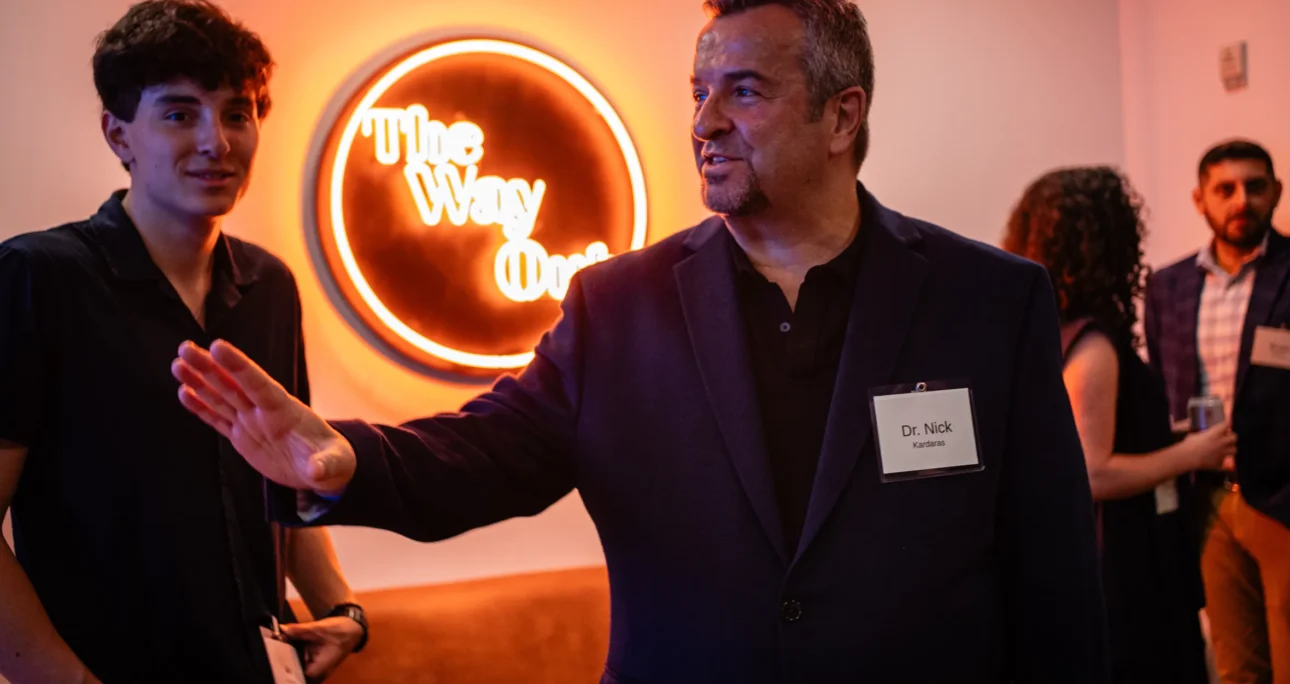
“There are psychiatric hospitals that will treat mental health, which tend to be not very pleasant places to go because they’re very institutional, and you have the traditional rehabs which will treat drug and alcohol,” Dr Nicholas Kardaras, who runs the program, told The Times. “Usually people that have drug and alcohol issues have underlying mental health issues, so there’s nowhere else that’s really meaningfully addressing the addictive element.”
Internet addiction is not a recognised clinical mental health diagnosis, but recent studies suggest as many as 20 per cent of young adults in the US have experienced some level of unhealthy addiction to the internet. For a proportion of those, it can become obsessive and even harmful.
“The internet is something that has always been involved in every part of my life as I’ve grown up,” said Luke on a recent afternoon between treatment sessions at the clinic. “I remember being in first grade and they rolled in a rack of iPads for all of us to use. Then in fifth grade, sixth grade, that’s when everyone was getting their own personal phones and downloading social media.
“By seventh grade I was equating playing a video game online to real social interaction. I thought it was the same as going out and hanging with friends,” he said.
Luke was diagnosed with ADHD, but recognised in himself a broader set of undiagnosed addictive traits. Research suggests that those with mental health conditions such as attention deficient disorders, anxiety and depression are more likely to overindulge in social media.
Research published by the National Institutes of Health has shown men and boys are generally more vulnerable to generalised internet addiction and significantly more prone to Internet Gaming Disorder (IGD). They are also statistically two to three times more likely to be diagnosed with ADHD in childhood than girls.
“You don’t realise how much time you’re actually losing to it because you think when you start ‘it’s only like a ten-second video’ but multiply ten seconds by a thousand, ten thousand and hours and hours are gone,” he said. “The only way I knew time was even passing sometimes was because I’m laying on my bed and then at some point I’m eating breakfast and then I’m brushing my teeth, my phone in my hand the whole time.”

With so many young people spending increasing amounts of time online, at what point does a hobby turn into an addiction? Mental health experts simply say the hours spent online is not enough for a diagnosis. “It goes from ‘Johnny likes his phone a lot’ to ‘oh, Johnny’s got a problem’ if their schooling, health, sleep, social relationships, or family life is significantly suffering,” Dr Kardaras said.
The Center for Living offers a 12-week full-time outpatient course, costing $8,500 (£6,300) without insurance. After the first 12 weeks it drops to two to three days a week for eight weeks and then down to one group therapy session a week for as long as needed.
When a new patient arrives they are made to leave their phones in a zip-lock bag at the reception. They are then evaluated by a trained psychiatrist.
Once enrolled, they take part in a combination of individual therapy sessions and group sessions. Parents are included if the patient is under the age of 18.
The Center for Living combines conventional therapy with art therapy, yoga and drama improvisation. On Fridays, Cesar Rosado, the program director, organises outings to rock-climbing centres and botanical gardens.
While other institutions offer digital-detox retreats and wilderness-therapy camps, short-term abstinence has not shown to translate into long-term behaviour change. Psychologists say that is because such an approach treats the cause and not the symptom of addiction, such as stress, anxiety, and social isolation.
“We have all of our clients create a community amongst themselves to make sure they’re socialising and not isolated,” Rosado said of their Alcoholics Anonymous-style “buddy system.” “It’s important that they learn to cope in the world in which they actually live and have to exist.”

Scientific studies suggest that social media usage activates the parts of the brain that respond to pleasurable experiences, called the reward pathway. “Kids are getting dopamine hits that mimic the highs you can get from some drugs,” said Kardaras, a trained psychologist who has spent over a decade studying online addiction in young people and wrote the books Glow Kids and Digital Madness.
Studies have shown excessive screen time affects the brain in the same way that chronic substance addiction does. “They’ve done MRI (Magnetic Resonance Imaging) research on this,” Kardaras said. “Digital media was not just mind shaping, but brain altering. If you look at the MRI of a brain that is excessively watching screens next to the MRI of an opiate addict, you’re going to see the same shrinkage in what’s called the prefrontal cortex — the dense grey matter of the prefrontal cortex.”
The prefrontal cortex located at the front of the brain controls impulses and evaluates the consequences of actions by acting as a “brake” on emotional responses.
Kardaras said the harmful effects of internet addiction have worsened with every generation. “Baby Boomers were the healthiest, then every generation after it got progressively worse. Facebook was popular among Gen X and older millennials, but it was static, you would just look at pictures. TikTok and Instagram Reels are the most damaging because of the short-form video content,” he said.
The younger the age at which screens are introduced, the more damaging the effects.
“I had a group of very smart young men in my clinic, most of whom were raised on screens since they were two or three years old,” he said. “I had one say to me, ‘Dr Kardaras, when I read a passage from a book, I can’t visualise it, it’s like the movie screen in my brain doesn’t work’. And I asked, ‘who else in this group has that problem?’ Every hand went up.
“Because the visual imagery, the imagination, had always been pre-baked for them, their ability to visualise never developed. In people who become addicted later in life, you can work on rebuilding those synapses, that muscle, but you cannot build on something that was never there.
“If you hit eight, nine, ten years old without forming it — it’s too late.”
Kardaras said screen-addicted adolescents tend to come from one of two types of households. There are the “neglectful” parents who leave their children to their own devices, but also the “helicopter” ones, “where the young person will say, ‘I escape in my screen time because my mom — or sometimes dad — is smothering me’.”
Luke falls into the latter category. The son of a physician and a lawyer living in the Upper East Side of Manhattan, he felt the weight of expectation.
“I wanted, needed, to be a high achiever, I was really trying to maintain a 4.0,” said Luke, who had attended Fordham Preparatory, the exclusive all-boys Catholic school, before moving out of the family home to Boston for university. “Video games and social media were a release from that pressure, a kind of escapism. But that just led me to having a worse mental state as time went on.”
Luke, who enrolled at the Center for Living in February, is coming to the end of his 12-week course.
He wants to continue with the once-a-week therapy sessions until he starts back at Northeastern in September.
“I think what was a breakthrough for me is realising that I was not getting out of social media what I thought I was. I was telling myself ‘this is relaxation, this is leisure, this is my social life’, but in reality it wasn’t any of those things,” he said. “It was about not wanting to face all the problems in my life and now I feel I’m in a place where I’m able to see that.”
Luke has adopted practical solutions too. He has started to use Brick, a physical hardware device designed to curb smartphone addiction by blocking distracting apps. “There’s no longer that immediate gratification system,” Luke said.

The day we met, however, he had forgotten it.
“I have felt my phone buzz in my pocket with notifications about 20 to 30 times since we sat down,” he told me mid-way through our hour-long interview.
“Before the therapy, every single time it went off I’d think ‘well, I need to check it immediately’. But now I’m able to resist it because we’ve worked on being mindful and disciplined,” he said.
“That might not seem like all that much to someone who hasn’t experienced addiction, but to me it feels pretty major.”