

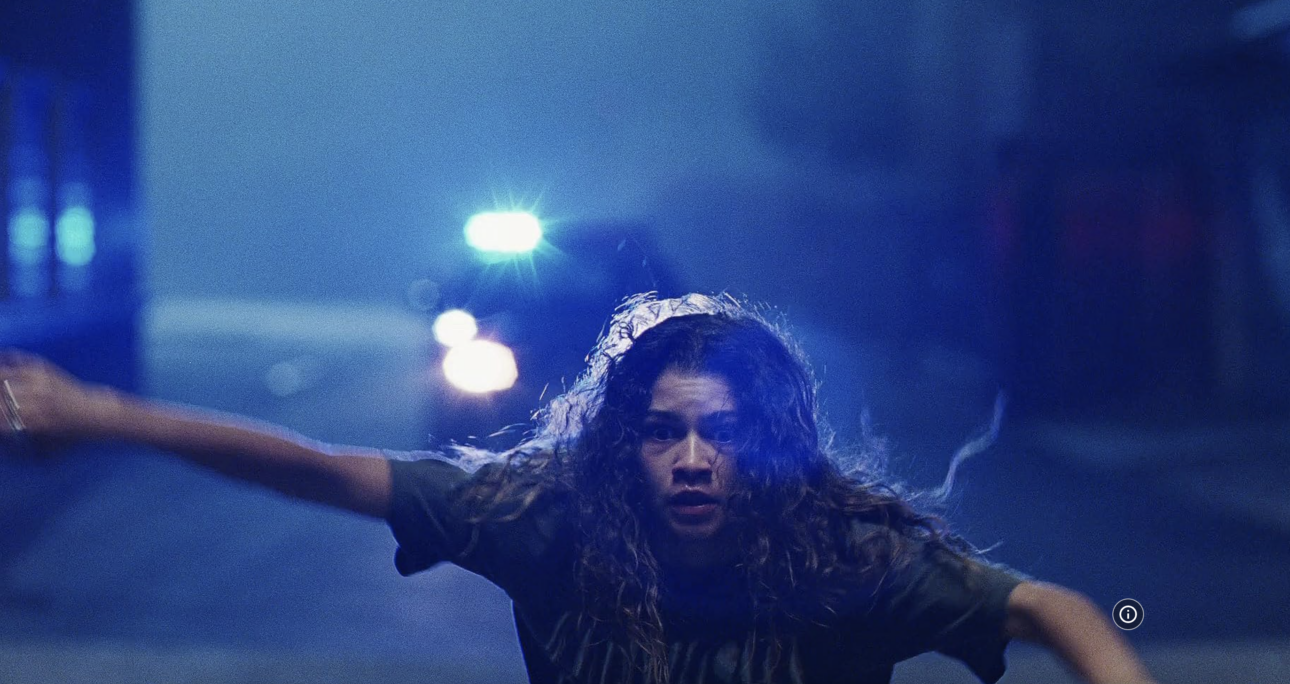
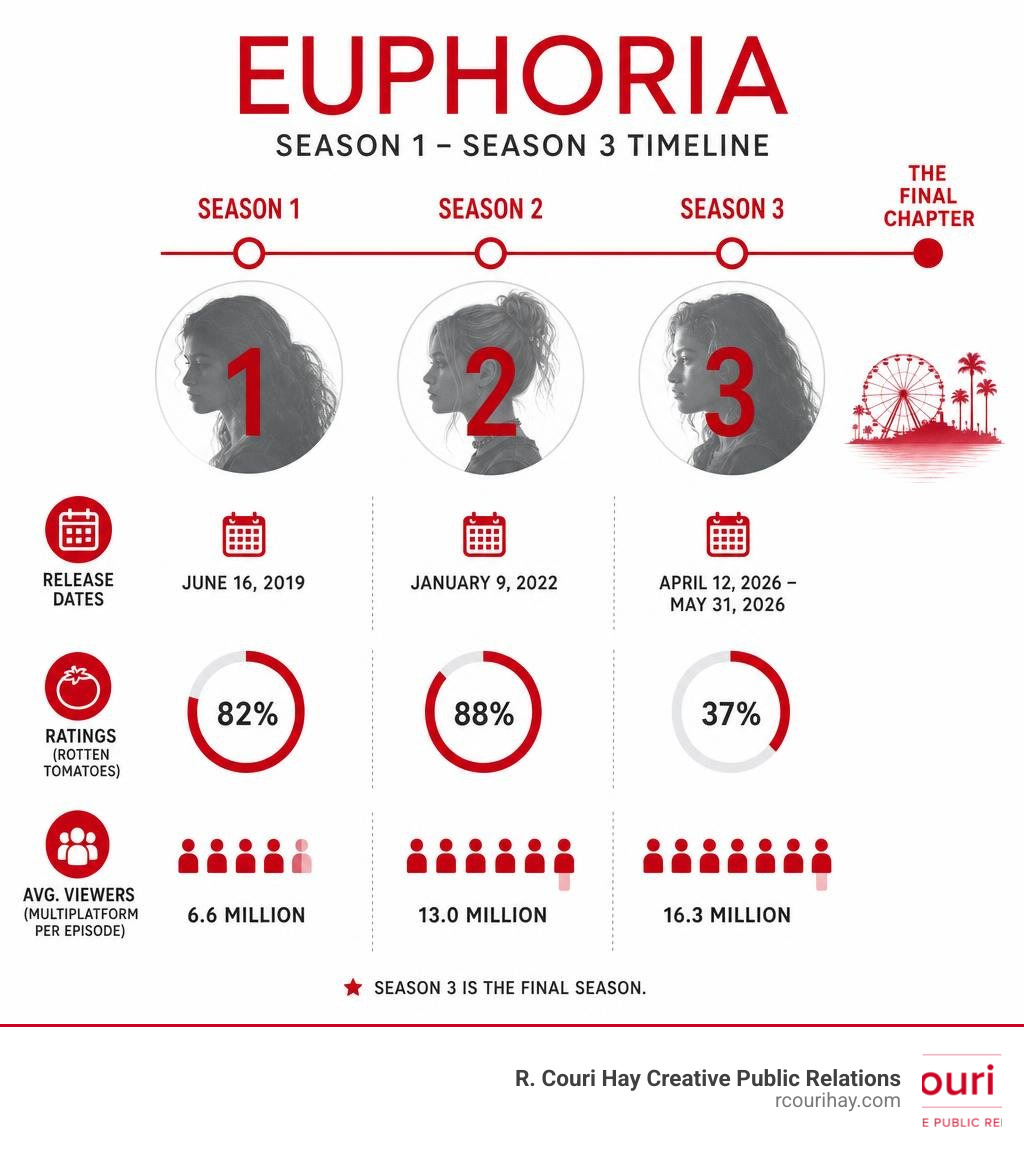
Euphoria Season 3 premiered on HBO on April 12, 2026, and ran through May 31, 2026 — bringing the acclaimed drama to a close after eight episodes.
Here’s what you need to know at a glance:
| Key Detail | Information |
|---|---|
| Premiere Date | April 12, 2026 |
| Finale Date | May 31, 2026 |
| Episodes | 8 |
| Network | HBO / Max |
| Creator | Sam Levinson |
| Time Jump | 5 years after Season 2 |
| Rue’s Fate | Dies from fentanyl overdose |
| Rotten Tomatoes | 37% |
| Avg. Viewers (multiplatform) | 16.3 million per episode |
| Final Season? | Yes |
The third and final season picks up five years after the events of Season 2, moving the characters out of high school and into the messier, less forgiving terrain of early adulthood. Rue is in Mexico. Cassie and Nate are engaged. Jules is at art school. The safety net is gone.
The season was also shaped by real-world tragedy. Angus Cloud, who played Fezco, passed away in 2023. Eric Dane, who played Cal Jacobs, died of ALS in February 2026 — just weeks before the premiere.
Despite pulling in massive multiplatform audiences, critics were divided. The show’s Rotten Tomatoes score dropped sharply from previous seasons — a contrast that sparked its own cultural conversation.
Whether you loved it or found it uneven, Euphoria Season 3 was impossible to ignore.
The Production and Release of Euphoria Season 3
The journey to bring Euphoria season 3 to our screens was one of the most highly anticipated, delayed, and technically ambitious undertakings in modern television history. After a four-year gap following the explosive Season 2 finale in 2022, the final season officially premiered on April 12, 2026, and concluded its run on May 31, 2026. Comprising eight cinematic episodes, the season allowed creator, writer, and director Sam Levinson to fully realize his visual and narrative goals for these beloved, troubled characters.
Behind the scenes, the scale of production was massive. Filming officially began on February 10, 2025, wrapping on November 15, 2025, after a grueling 176 filming days. The production costs totaled a staggering $96,685,000. Much of the filming took place on location across Southern California, capturing the gritty yet beautiful landscapes of Los Angeles. To support this massive endeavor, the production received a $19,406,000 tax credit for employing over 15,000 people in California, keeping the industry buzzing in one of our key agency hubs.
From a technical standpoint, Levinson pushed the boundaries of television cinematography. We saw a complete departure from the digital look of earlier seasons. Instead, Season 3 was filmed entirely on Kodak motion picture film stock using both 35mm and 65mm cameras in a wide CinemaScope aspect ratio. It stands as the first narrative television series to shoot a significant volume of 65mm film.
In a fascinating behind-the-scenes detail, Levinson requested one million feet of Ektachrome film from Kodak. When initially told it was not in active production, he jokingly offered to buy it out, leading Kodak to manufacture a custom stock for the show. The production ultimately utilized a brand-new, custom-created film stock called Verita 200D 5206, which gave the season a rich, objective, and deeply cinematic texture. For more on how these choices came together, you can read the Euphoria season 3 production details.
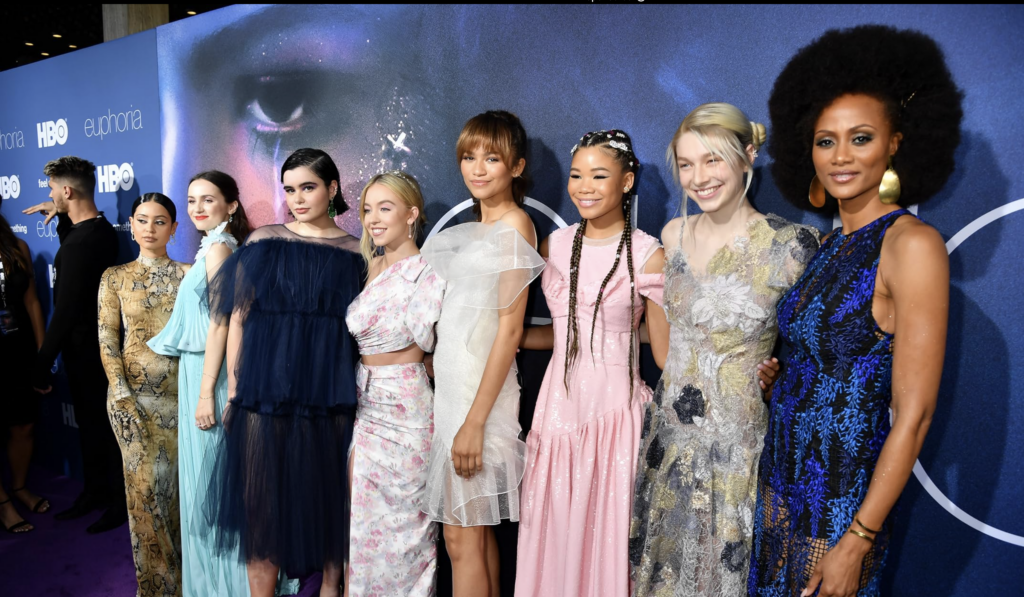
The high production value was matched by the star power on screen. Zendaya, who returned as executive producer and star, negotiated a historic salary of $1,000,000 per episode for this final season. However, the auditory landscape of the show underwent a major shift. The brilliant British musician Labrinth, whose ethereal beats defined the first two seasons, departed the project. In his place, legendary composer Hans Zimmer took over the reins, delivering a sweeping, dramatic solo score. Zimmer’s orchestration brought an entirely different, almost operatic weight to the series, though some fans experienced whiplash adjusting to the departure of Labrinth’s signature electronic style.
Five Years Later: Plot and Character Arcs
To transition the series away from high school hallways and into what Sam Levinson calls the “Wild West of adulthood,” euphoria season 3 implements a dramatic five-year time jump. This narrative choice strips the characters of their parental safety nets, forcing them to confront the real-world consequences of their teenage trauma.
- Rue Bennett (Zendaya): Rue’s journey takes her far from East Highland. We find her in Mexico, deeply entangled in the dangerous drug debt she owed to the chilling dealer Laurie from Season 2. Her life is a high-stakes game of survival, driving cars across makeshift border ramps and attempting to outrun a dark underworld.
- Jules Vaughn (Hunter Schafer): Jules is living in the city, attending a prestigious art school. While she has found an outlet for her creativity, she is plagued by intense anxiety regarding her future as a professional painter and the lingering psychological scars of her relationship with Rue.
- Maddy Perez (Alexa Demie): Maddy has relocated to the glamorous hills of Hollywood. Working at a talent agency, she balances her corporate ambitions with various side hustles, trying to carve out a name for herself in a ruthless industry.
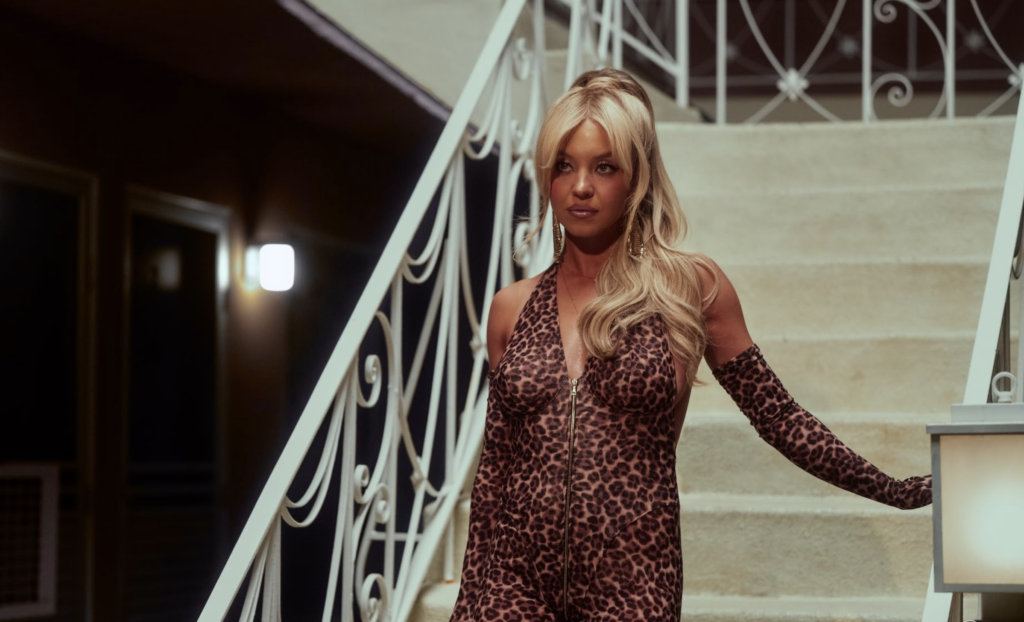
- Cassie Howard (Sydney Sweeney) & Nate Jacobs (Jacob Elordi): In a shocking twist that polarized fans, Cassie and Nate are engaged and living in suburban domesticity. However, their relationship remains as toxic and volatile as ever, culminating in a disastrous wedding day sequence featuring brutal physical altercations and dark comedic beats.
- Lexi Howard (Maude Apatow): Lexi has parlayed her theatrical talents into a career in the entertainment industry, working as an assistant to a prominent television showrunner, trying to write her own story rather than watching from the sidelines.
Much like the ensemble dynamics we see in the Cast of Yellowjackets, the characters of Euphoria are bound together by shared trauma, even as their adult lives pull them in wildly different directions.
Explaining the Shocking Series Finale and Character Fates
The series finale of Euphoria season 3 is a devastating, heart-wrenching conclusion that firmly rejects easy answers or Hollywood happy endings. For years, viewers wondered if Rue Bennett would find lasting recovery. Tragically, her storyline concludes with her ultimate demise. Rue dies from a drug overdose after taking lethal fentanyl pills given to her by Alamo Brown (Adewale Akinnuoye-Agbaje), which were disguised as ordinary pain medication. It is a sobering, realistic look at the ongoing opioid and fentanyl crisis.
The finale also delivers a violent reckoning for the show’s criminal underworld. Ali Muhammad (Colman Domingo), acting as a protective father figure, seeks ultimate revenge. In a dramatic, tense duel, Ali kills Alamo Brown. The confrontation succeeds because Bishop (Darrell Britt-Gibson) betrays Alamo, handing him an unloaded gun before the showdown.
For a detailed breakdown of how these final moments came together and what they mean for the characters’ legacies, you can watch the Euphoria Season 3 Finale Explained video featuring insights from the creator himself.
How Euphoria Season 3 Addressed Cast Departures
The production of Season 3 had to navigate severe real-world losses and cast exits, which heavily reshaped the narrative. The most painful departure was that of Angus Cloud, who tragically passed away at age 25 in the summer of 2023. Because Cloud’s character, Fezco, was the beating heart of the show’s moral gray area, Levinson chose not to recast him. Instead, Fezco’s ultimate fate is left unrevealed in the real world. In a moving tribute during the finale, a dream sequence shows Fezco successfully escaping his legal troubles, offering fans a bittersweet moment of closure.
Another heavy loss occurred when Eric Dane, who played the complex and deeply flawed Cal Jacobs, passed away from ALS in February 2026. Fortunately, Dane was able to complete all of his filming obligations before his passing, allowing Cal’s tragic and intense storyline to reach its intended conclusion.
Additionally, the show had to write around several living cast departures. Barbie Ferreira, who played Kat Hernandez, chose not to return for the final season. Similarly, Storm Reid (Gia Bennett), Algee Smith (Chris McKay), and Austin Abrams (Ethan Daley) did not return, reflecting the natural drifting apart of high school acquaintances over a five-year span. To learn more about how the creative team managed these transitions, check out the feature Inside ‘Euphoria’ Season 3.
Critical Reception, Controversies, and Cultural Impact
The reception to Euphoria season 3 was vastly different from the near-universal acclaim of its predecessor. Critics and audiences found themselves deeply divided over the time jump, the tonal shift, and the bleakness of the character resolutions.
On Rotten Tomatoes, Season 3 received a rotten score of 37% based on 54 reviews, with critics describing the season as “entertaining but disjointed fan fiction.” Metacritic reflected a similar sentiment, awarding the season a score of 56 out of 100 based on 26 critic reviews. Many reviews praised the astonishing acting—particularly from Zendaya and Sydney Sweeney—and the jaw-dropping 65mm cinematography, but heavily criticized the pacing, writing, and the jarring transition from Labrinth’s music to Hans Zimmer’s orchestral arrangements.
Despite the critical backlash, the show remained an absolute ratings juggernaut. It solidified its place as the second-most-watched HBO series since 2004, trailing only Game of Thrones. Across all platforms, episodes averaged a massive 16.3 million viewers. While linear cable numbers were modest (averaging 0.340 million viewers per episode, with the premiere pulling in 0.356 million), the digital streaming numbers on Max were astronomical. The premiere alone drew 2.4 million viewers across all platforms on its first night.
Furthermore, the show’s cultural footprint on social media remained unmatched. Euphoria was the most tweeted television series of the 2020s in the United States, generating over 30 million tweets. If you want to experience the drama and form your own opinion, you can Watch Euphoria Season 3 on HBO Max.
The Themes and Legacy of Euphoria Season 3
At its core, the legacy of Euphoria lies in its uncompromising exploration of addiction, trauma, and the elusive nature of redemption. By ending Rue’s life with a fentanyl overdose, the show avoided the cliché of an easy recovery, reminding viewers of the lethal stakes of substance abuse. It served as a dark mirror to the struggles of Gen Z, capturing the anxiety of transitioning into an unforgiving adult world.
While fans of coming-of-age dramas might look to the lighter, more romantic tones found in the Never Have I Ever Cast, Euphoria chose a path of raw, psychological realism. With Season 3 officially confirmed as the series finale, the franchise has reached its definitive end. HBO executives have confirmed there are no spin-offs or future seasons in development, leaving the three-season run as a complete, tragic monument to youth in the 2020s.
Frequently Asked Questions about the Series
Why did Labrinth leave the show?
Labrinth, whose iconic score defined the aesthetic of the first two seasons, departed before Season 3 to pursue other creative endeavors. Creator Sam Levinson brought in legendary film composer Hans Zimmer to score the final season solo, utilizing sweeping, orchestral arrangements to match the older, more mature themes of adulthood.
Is there going to be a fourth season?
No. HBO and creator Sam Levinson have officially confirmed that Season 3 is the final season of Euphoria. The story of Rue Bennett and her classmates has concluded, and there are currently no plans for spin-offs or sequels.
How did Cal Jacobs’ storyline end?
Cal Jacobs’ arc reached a definitive and somber conclusion in Season 3. Actor Eric Dane completed all of his scenes for the character before sadly passing away from ALS in February 2026, ensuring that Cal’s complex relationship with his family and his past was fully resolved on screen.
Conclusion
At R. Couri Hay Creative Public Relations, we are constantly analyzing the major pop culture touchstones that shape our cultural landscape. From the star-studded streets of Los Angeles to the high-society circles of New York, Southampton, London, and Paris, Euphoria season 3 has been the defining television event of the year. It challenged viewers, sparked crucial conversations about mental health and addiction, and pushed the boundaries of visual storytelling. Though it has come to a tragic end, its impact on television history and Gen Z culture will be felt for decades to come.