
What Is March Madness? The Essential Guide to the NCAA Tournament

March Madness is the annual NCAA Division I men’s basketball tournament — a 68-team, single-elimination championship that captivates the entire United States every spring.
Here’s a quick snapshot of what you need to know:
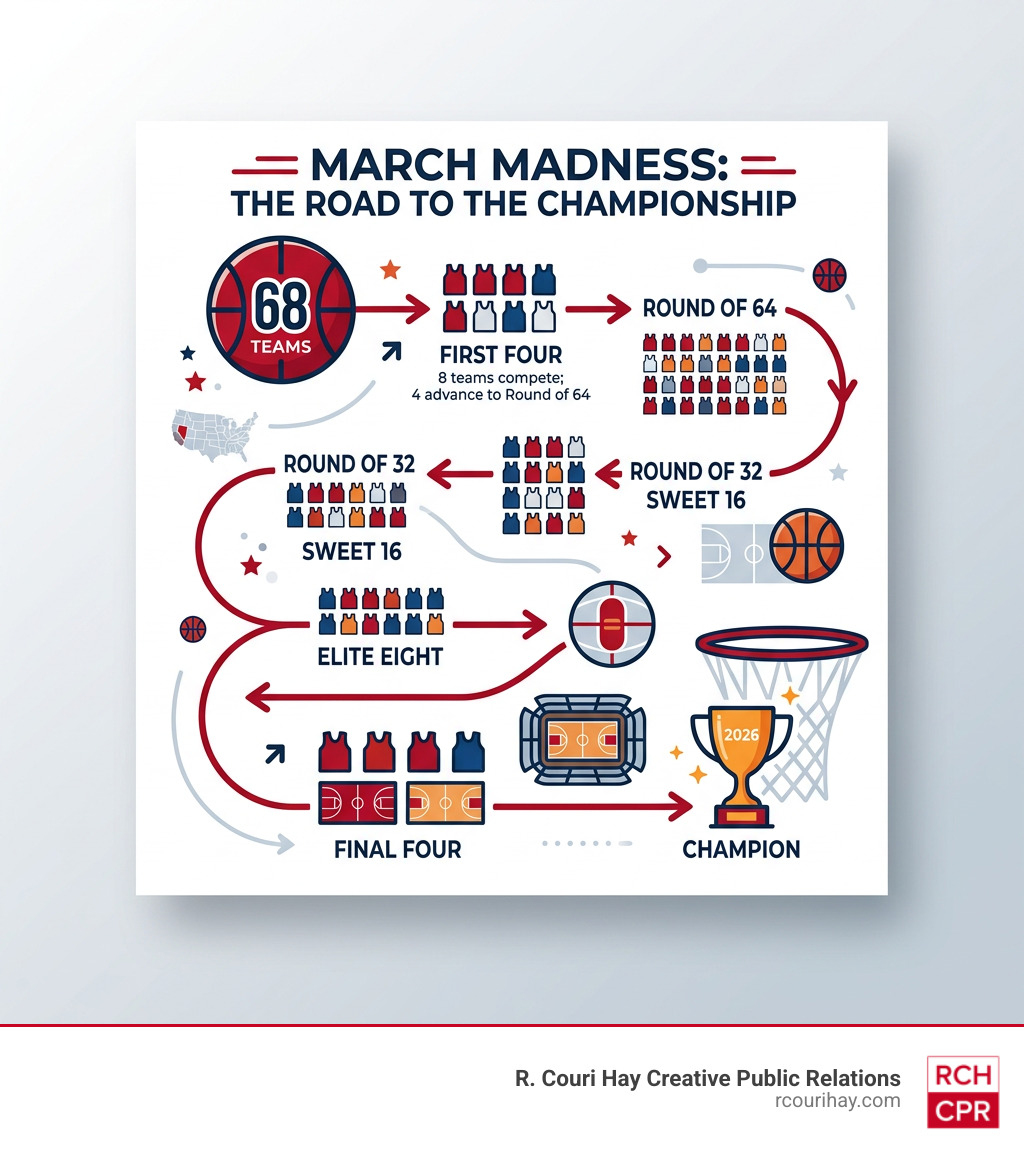
- What: Single-elimination college basketball tournament, 68 teams, 7 rounds
- When: Mid-March through early April (2026: Selection Sunday is March 15; Championship is April 6)
- Where: Games held across the U.S.; 2026 Final Four and Championship at Lucas Oil Stadium in Indianapolis
- Who wins: One champion crowned after 67 total games
- How to follow: Live on CBS, TBS, TNT, and truTV; brackets available at NCAA.com
It’s more than a sports event. An estimated 60 to 100 million brackets are filled out each year, making it one of the biggest cultural moments in American sports. Office pools, family group chats, and last-minute upsets — March Madness touches almost everyone.
The tournament has been running since 1939. Today, 37 different schools have won the title. UCLA leads all programs with 11 championships.
Whether you want to fill out a winning bracket, follow your favorite team, or simply understand what everyone is talking about — this guide covers it all.
The 2026 March Madness Schedule and Key Dates
The road to the championship is a whirlwind of high-stakes basketball that spans exactly three weeks. For fans in our key hubs like New York, Palm Beach, and Los Angeles, the excitement begins the moment the selection committee reveals the field. The 2026 journey officially kicks off with Selection Sunday on March 15. This is when the 68-team field is unveiled during a live national broadcast on CBS at 6 p.m. ET, and millions of fans immediately rush to download their Official 2026 Tournament Schedule.
The tournament begins in earnest with the First Four in Dayton, Ohio, at the UD Arena. This venue has become a hallowed ground for programs fighting just to enter the main bracket. From there, the action moves to various pods across the country for the First and Second rounds, eventually narrowing the field to the regional sites. The 2026 tournament will culminate at the massive Lucas Oil Stadium in Indianapolis, a city that has become a “Final Four regular” due to its central location and world-class facilities.
Key Dates for the 2026 March Madness Tournament
To ensure you don’t miss a single buzzer-beater, keep these essential dates marked on your calendar:
- Selection Sunday: March 15, 2026
- First Four: Tuesday, March 17, and Wednesday, March 18
- First Round: Thursday, March 19, and Friday, March 20
- Second Round: Saturday, March 21, and Sunday, March 22
- Sweet 16: Thursday, March 26, and Friday, March 27
- Elite Eight: Saturday, March 28, and Sunday, March 29
- Final Four Saturday: April 4
- National Championship Monday: April 6
How the NCAA Tournament Bracket Works
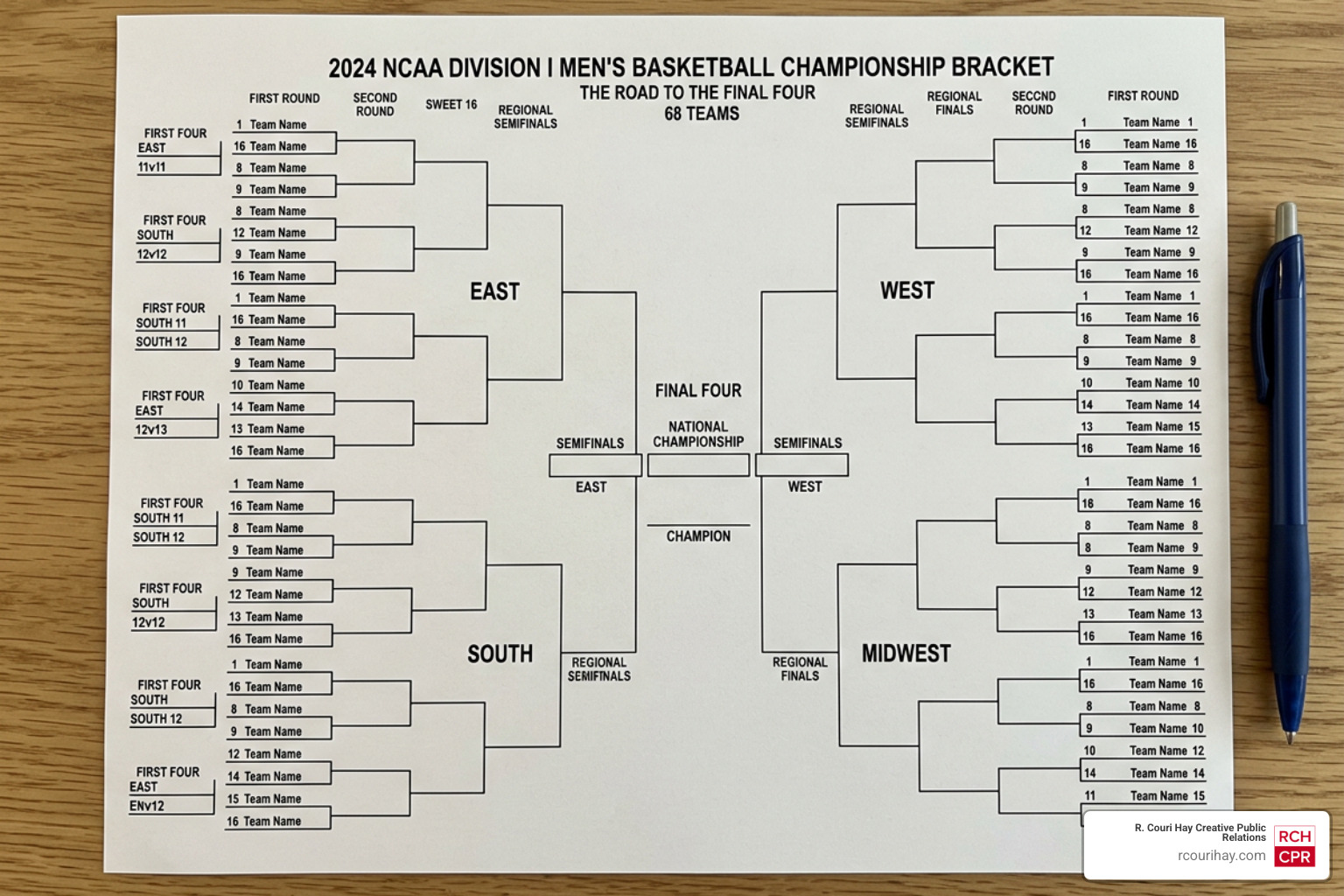
Understanding the bracket is the first step toward winning your office pool. The process of building the field is handled by the NCAA Selection Committee, which uses a variety of metrics, most notably the NET (NCAA Evaluation Tool) rankings. The field is composed of 32 automatic bids—teams that win their respective conference tournaments—and 36 at-large selections. These at-large spots go to the best remaining teams in the country as determined by the committee.
Once the 68 teams are chosen, they are placed into four regions: East, West, South, and Midwest. Each team is given a seed from 1 to 16. A #1 seed is considered the strongest team in their region, while a #16 seed faces the steepest uphill battle. You can grab a Printable 2026 Bracket to start mapping out your own predictions.
Automatic Qualifiers vs At-large Bids
Understanding the First Four and Seeding
The “First Four” refers to the four play-in games held in Dayton. This round features the four lowest-seeded automatic qualifiers (usually #16 seeds) and the four lowest-seeded at-large teams (usually #11 seeds). The winners of these games advance to the main 64-team bracket.
In “bracketology,” a term popularized to describe the science of predicting the field, there is immense focus on “bubble teams.” These are the schools hovering right on the edge of making the tournament. On Selection Sunday, we see the “Last Four In”—the final teams to make the cut—and the “First Four Out,” the heartbreaking list of teams that just missed their chance at the Big Dance.
Top Teams and Players to Watch in 2026 March Madness
As we look toward the 2026 tournament, several powerhouse programs are already generating significant buzz. Duke University, led by the highly anticipated Cameron Boozer, is expected to be a major force. Boozer, who headlines the 2025-26 AP All-America team, is widely considered a top prospect for the NBA. After a stellar championship run in 2025, the Florida Gators will enter the season as defending champions with a target on their backs.
Other perennial contenders like Arizona, Kansas, and UConn remain at the top of the rankings. UConn, in particular, has shown incredible resilience in recent years, while Purdue and Michigan State continue to be staples of the tournament landscape. Fans should keep a close eye on the NBA Future Stars emerging from these rosters, as March Madness is often the ultimate audition for the professional ranks.
Breakout Stars and NBA Prospects
The tournament is the premier stage for players to skyrocket their draft stock. We often see “one-and-done” freshmen use a deep tournament run to solidify their status as lottery picks. Looking ahead to the 2025 NBA Season, scouts are already pouring over reports for the National Player of the Year candidates.
Beyond the superstars, every year brings “tournament sleepers”—players from smaller schools who catch fire in March. These breakout stars often lead their teams to unexpected victories, becoming household names overnight. Whether it’s a sharpshooting guard from a mid-major or a dominant big man in the Big Ten, these players define the “madness” in March Madness.
A Look Back: 2025 Highlights and All-Time Legends
The 2025 tournament was one for the history books. The Florida Gators secured their third national title by defeating the Houston Cougars in a nail-biting 65-63 final. Florida’s path to victory was grueling, requiring them to navigate a region filled with upsets before overcoming a resilient Auburn team in the Final Four. You can Watch the 2025 Championship Highlights to relive the tension of those final seconds.
Historically, the tournament is defined by its legends. UCLA remains the gold standard with 11 national titles, 10 of which were won under the legendary John Wooden. Kentucky follows with 8 titles, while North Carolina and Duke have also cemented their status as blue-blood programs. These schools have produced some of the greatest players in basketball history, from Kareem Abdul-Jabbar to Christian Laettner.
Notable Upsets and Buzzer-Beaters
Nothing captures the spirit of March Madness quite like a Cinderella story. We still talk about UMBC making history as the first #16 seed to topple a #1 seed when they beat Virginia in 2018. In 2025, we saw another shocker when #12 McNeese upset #5 Clemson, continuing the long-standing trend of 12-seeds being dangerous opening-round opponents.
The tournament’s highlight reel is filled with iconic moments:
- Christian Laettner’s turnaround jumper for Duke against Kentucky in 1992.
- The 1979 title game featuring Magic Johnson vs. Larry Bird, which remains the most-watched college basketball game ever.
- Florida Gulf Coast’s “Dunk City” run in 2013, where they became the first #15 seed to reach the Sweet 16.
The Business and Culture of March Madness
The economic impact of the tournament is staggering. The NCAA generates approximately $891 million annually in broadcast rights fees from CBS and Turner Sports through 2032. However, the tournament’s influence extends far beyond the court. It is estimated that American businesses lose billions in productivity as workers spend time checking scores and filling out an estimated 60 to 100 million brackets.
In our world of luxury lifestyle and high-end branding, the tournament has become a key platform for sophisticated marketing campaigns. For example, the Dove Men+Care: Off Court Champs initiative successfully used the tournament to challenge stereotypes of Black men by celebrating their professional achievements outside of athletics.
As we look to the future, the Final Four sites have been selected through 2031, with games heading to iconic locations like Las Vegas, Detroit, and North Texas. These host cities experience a massive surge in tourism and media attention, further solidifying March Madness as a premier event on the global sporting calendar.
Frequently Asked Questions about March Madness
Who won the 2025 NCAA Men’s Basketball Championship?
The Florida Gators won the 2025 championship, defeating the Houston Cougars 65-63. This marked the program’s third national title. Florida’s path included a dominant win over Norfolk State in the opening round and a hard-fought victory over Auburn in the Final Four before the dramatic finale against Houston.
Where is the 2026 Final Four being held?
The 2026 Final Four and National Championship will be held at Lucas Oil Stadium in Indianapolis, Indiana. The semifinals will take place on Saturday, April 4, with the championship game following on Monday, April 6. Indianapolis is a frequent host for the event, known for its basketball-rich history and walkable downtown area.
How many teams are in the March Madness field?
There are currently 68 teams in the field. This includes 32 automatic qualifiers (conference champions) and 36 at-large bids selected by the NCAA committee. The tournament officially begins with the First Four, which narrows the field to the traditional 64-team bracket.
Conclusion
At R. Couri Hay Creative Public Relations, we understand that March Madness is more than just a series of basketball games—it is a cultural touchstone that blends sports, business, and luxury lifestyle. From the high-stakes environment of the arenas in Indianapolis to the sophisticated branding campaigns that launch during the broadcasts, the tournament represents the pinnacle of American entertainment and competitive spirit.
As the tournament continues to evolve, its legacy as a platform for brand innovation and athletic excellence only grows stronger. Whether you are following the latest breakout star or managing a high-profile PR campaign tied to the games, the energy of March is undeniable. To stay updated on the intersection of sports, celebrity, and the New York social scene, be sure to Get the latest lifestyle and celebrity news through our exclusive updates. We look forward to seeing who will cut down the nets in 2026!