
The Golden State Warriors: A Sports Brand and PR Case Study
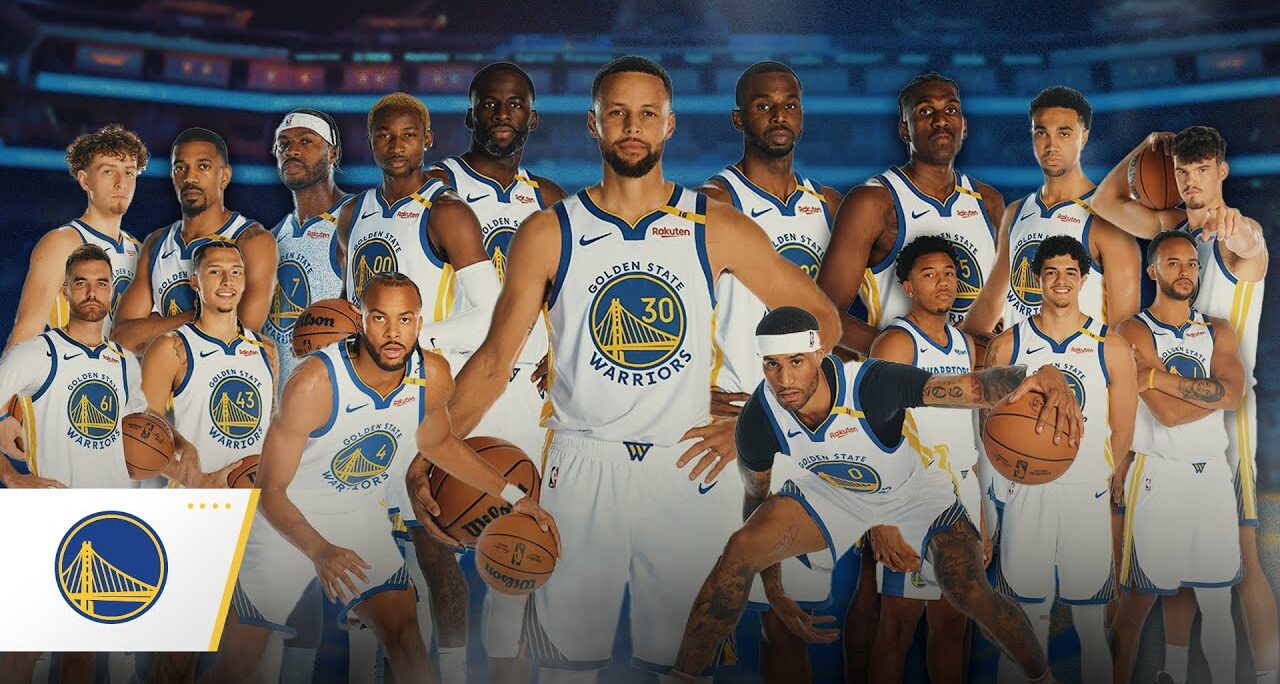
The Warriors are not only one of the most decorated franchises in professional basketball history. They are also a powerful case study in modern branding, sports storytelling, fan culture, luxury hospitality, and global media visibility.
For a public relations and lifestyle audience, the Warriors offer a clear example of how a team can evolve from a regional sports franchise into an international cultural brand. Their story includes 7 NBA championships, a record-breaking 73-win season, a move into a state-of-the-art San Francisco arena, and a dynasty built around some of the most marketable athletes in basketball.
Quick facts about the Warriors:
- Full name: Golden State Warriors
- Founded: 1946 in Philadelphia, PA
- Current home: Chase Center, San Francisco, CA
- Championships: 7 (1947, 1956, 1975, 2015, 2017, 2018, 2022)
- All-time leading scorer: Stephen Curry
- Notable records: Best single-season record in NBA history (73-9 in 2015-16)
- Head coach: Steve Kerr
- Nickname: The Dubs, short for W’s
From their origins as a Philadelphia charter member of the Basketball Association of America, to Wilt Chamberlain’s legendary 100-point game, to Stephen Curry rewriting the three-point record books, the Warriors’ story spans eight decades of reinvention.
That reinvention is what makes the franchise especially relevant to R. Couri Hay Creative Public Relations. The team demonstrates how heritage, celebrity, performance, media access, design, venue experience, and community loyalty can combine to create a brand that reaches far beyond the court.
This guide looks at the Warriors through both a basketball and communications lens: franchise history, championship eras, iconic players, current brand positioning, rivalries, fan culture, and the lessons luxury, lifestyle, and sports PR professionals can draw from one of the NBA’s most visible organizations.
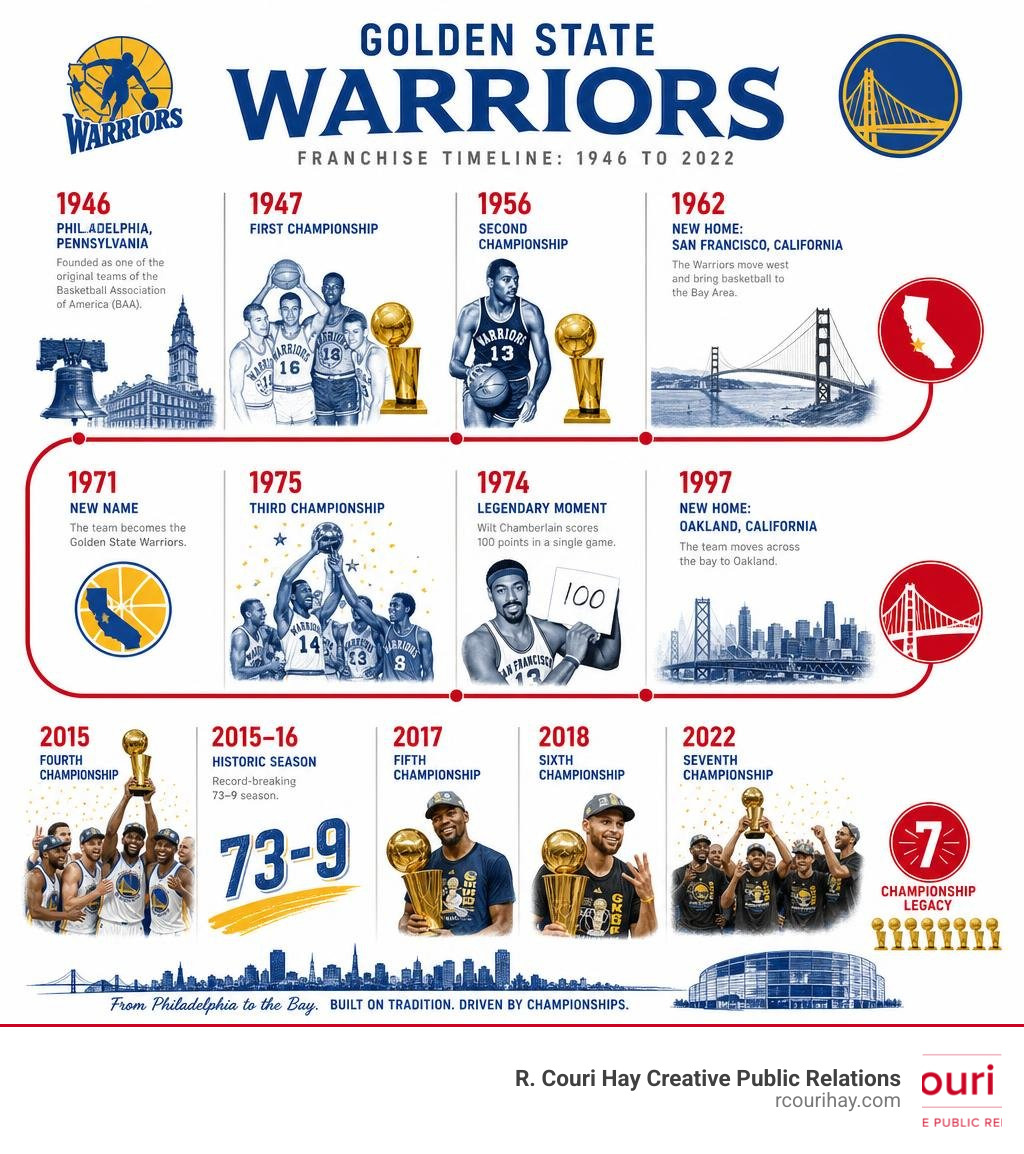
The History and Relocation of the Warriors Franchise
The journey of the Warriors franchise is a cross-country brand evolution: three cities, multiple name changes, changing arenas, and a steady effort to stay relevant as the NBA grew from a young league into a global entertainment platform.
For communications professionals, the Warriors’ relocation history is more than a sports timeline. It shows how geography, identity, audience development, and market positioning can reshape a public brand over time.
Philadelphia Roots and Early NBA Championships
The franchise was founded in 1946 as the Philadelphia Warriors, a charter member of the Basketball Association of America (BAA), which later merged with the National Basketball League to form the NBA.
Led by early league star Joe Fulks, the Philadelphia Warriors captured the inaugural 1947 BAA championship by defeating the Chicago Stags. That victory gave the franchise a permanent place in basketball history as the league’s first champion. Nearly a decade later, in 1956, the team secured its second championship in Philadelphia, powered by Hall of Famers Paul Arizin and Neil Johnston.
Those early titles created the kind of institutional heritage that modern sports brands continue to use in storytelling, anniversary campaigns, merchandise, and fan engagement. To explore the complete franchise chronology and season-by-season history, see the comprehensive Golden State Warriors – Wikipedia page.
Moving West: San Francisco and the Golden State Transition
In 1962, majority owner Franklin Mieuli relocated the franchise to the West Coast and renamed it the San Francisco Warriors. The move brought professional basketball to a growing California market and positioned the team inside a region that would later become one of the world’s most influential centers for technology, wealth, media, and lifestyle culture.
The team split home games among venues such as the Cow Palace in Daly City, the San Francisco Civic Auditorium, and occasionally the War Memorial Gymnasium. Despite reaching the NBA Finals in 1964 and 1967, the franchise continued searching for a stronger regional identity and a more stable home.
In 1971, the team relocated across the bay to Oakland, moving into the Oakland Coliseum Arena, later known as Oracle Arena. The franchise also rebranded as the Golden State Warriors, choosing a name that spoke to the wider California audience rather than a single city.
That decision became an important branding move. The Golden State name allowed the organization to connect with fans across the Bay Area and beyond, setting the stage for the team’s later emergence as a global sports and lifestyle property.
Championship Eras and Historic NBA Records
Throughout their history, the Warriors have produced moments that function as more than box-score achievements. Championships, records, and postseason runs have become the foundation of the franchise’s public mythology and media appeal.
In PR terms, these moments are brand assets. They create narratives that can be retold across broadcasts, documentaries, social media, sponsorship campaigns, athlete profiles, and premium fan experiences.
The Dominance of Wilt Chamberlain and Rick Barry
No discussion of early franchise history is complete without Wilt Chamberlain. Drafted by the Philadelphia Warriors in 1959, Chamberlain was an athletic marvel who changed the scale of what an NBA star could be. On March 2, 1962, in a game against the New York Knicks in Hershey, Pennsylvania, Chamberlain scored 100 points in a single game, a record that still stands.
Chamberlain’s performance remains one of the most recognizable achievements in American sports. It continues to give the Warriors a connection to one of basketball’s defining legends, even though the game took place long before the modern media era.
Nate Thurmond later became another central figure in the franchise story, anchoring the paint and building a Hall of Fame reputation through defense, rebounding, and durability.
Following Chamberlain’s departure, the next great Warriors era was defined by Rick Barry. Known for his underhand free-throw style and intense competitive drive, Barry led the team to one of the most surprising championship runs in NBA history in 1975. Facing the heavily favored Washington Bullets, the Warriors completed a four-game sweep to capture their first title after relocating to California.
The Splash Brothers and the Modern Warriors Dynasty
After a long championship drought, the modern Warriors era began to take shape with the drafting of Stephen Curry in 2009, Klay Thompson in 2011, and Draymond Green in 2012. Curry and Thompson became known as the Splash Brothers because of their extraordinary shooting range, while Green became the emotional, defensive, and playmaking connector of the dynasty.
Under head coach Steve Kerr, who took over in 2014, the team implemented a ball-sharing system built on spacing, pace, shooting, cutting, and defensive versatility. In the 2014-15 season, the Warriors finished 67-15 and won their first NBA championship in 40 years.
The following season, the 2015-16 Warriors went 73-9, breaking the NBA record for most regular-season wins. Although they did not win the title that year, the record helped turn the team into a global media phenomenon. The later addition of Kevin Durant in 2016 created one of the most talented rosters in league history, and the team won back-to-back championships in 2017 and 2018.
The 2022 championship further strengthened the dynasty narrative, showing how continuity, star power, coaching, and culture can extend a team’s relevance across multiple media cycles. For official franchise milestones, rosters, highlights, and team updates, visit the Golden State Warriors Team Info and News | NBA.com portal.
Evolution of Roster, Playing Style, and Iconic Eras
The Warriors have repeatedly influenced how basketball is played, watched, discussed, and marketed. Their most famous eras show how a clear style can become a public identity.
For a PR and brand strategy audience, that matters. Teams with a recognizable style are easier to explain, promote, package, and remember. The Warriors have built multiple such identities, from fast-break entertainment to the three-point revolution.
From Run TMC to the We Believe Warriors
In the late 1980s and early 1990s, head coach Don Nelson introduced Nellie Ball, a high-tempo, small-ball system that prioritized speed, spacing, and offensive creativity over traditional post play. The best-known version of this style was Run TMC, the high-scoring trio of Tim Hardaway, Mitch Richmond, and Chris Mullin.
Run TMC never won a championship, but it became a cultural marker for fans who loved fast, stylish, offensive basketball. The era remains important because it showed how entertainment value can strengthen a franchise’s identity even without a title.
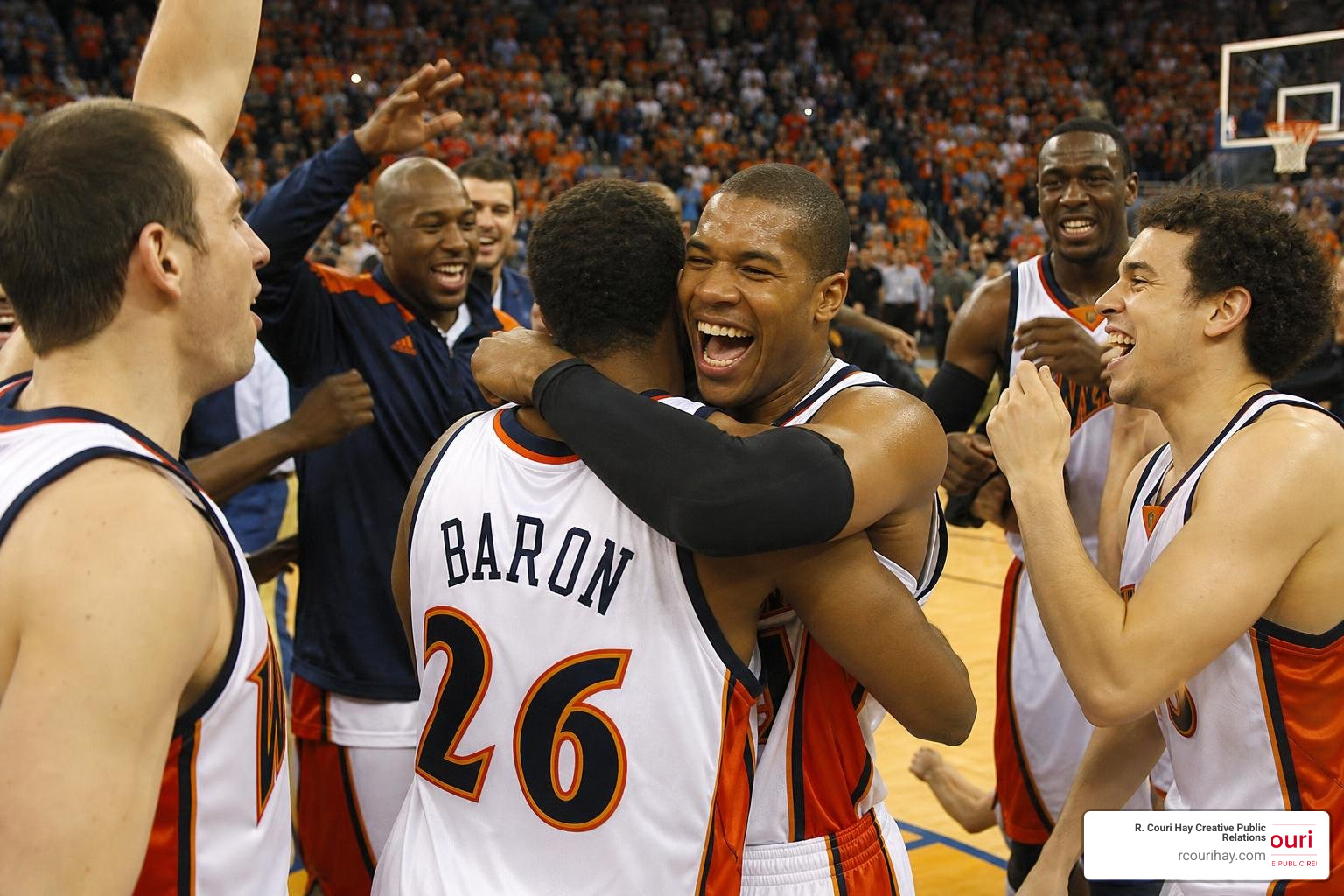
Years later, the 2006-07 We Believe Warriors, led by Baron Davis, Stephen Jackson, and Jason Richardson, captured national attention with a fearless, energetic style. They made history by becoming the first No. 8 seed to defeat a No. 1 seed in a best-of-seven playoff series when they upset the Dallas Mavericks.
That upset became a masterclass in underdog storytelling. The slogan, fan atmosphere, visual identity, and playoff drama turned one series into a lasting brand memory.
The Death Lineup and the Three-Point Revolution
When Steve Kerr arrived, he took the principles of up-tempo basketball and combined them with elite defense, movement, and lineup flexibility. This produced the Death Lineup, a small-ball unit featuring Stephen Curry, Klay Thompson, Andre Iguodala, Harrison Barnes, and Draymond Green at center.
By sacrificing traditional size for speed, shooting, playmaking, and switching defense, the Warriors changed the way the league thought about lineup construction. The Kevin Durant years later expanded the concept even further, creating a version of the team that was both tactically innovative and commercially magnetic.
To understand how the team’s style evolved over time, consider this comparison:
| Feature | Run TMC Era (1989-1991) | Splash Brothers Dynasty (2014-2022) |
|---|---|---|
| Core Trio | Tim Hardaway, Mitch Richmond, Chris Mullin | Stephen Curry, Klay Thompson, Draymond Green |
| Head Coach | Don Nelson | Steve Kerr |
| Primary Style | Ultra-fast transition, Nellie Ball | Heavy 3-point shooting, off-ball movement, switching defense |
| Championships | 0 | 4 (2015, 2017, 2018, 2022) |
| Peak Season Record | 44-38 (1990-91) | 73-9 (2015-16) |
Current Team Profile: Ownership, Roster, and Chase Center
In 2010, an ownership group led by Joe Lacob and Peter Guber purchased the Warriors for a then-record $450 million. Under their leadership, the organization became one of the NBA’s clearest examples of how sports, entertainment, technology, real estate, luxury hospitality, and media can work together.
That transformation is especially relevant to R. Couri Hay Creative Public Relations because it reflects the same forces that shape luxury and lifestyle visibility: elite venues, influential audiences, celebrity attendance, premium partnerships, and carefully managed storytelling.
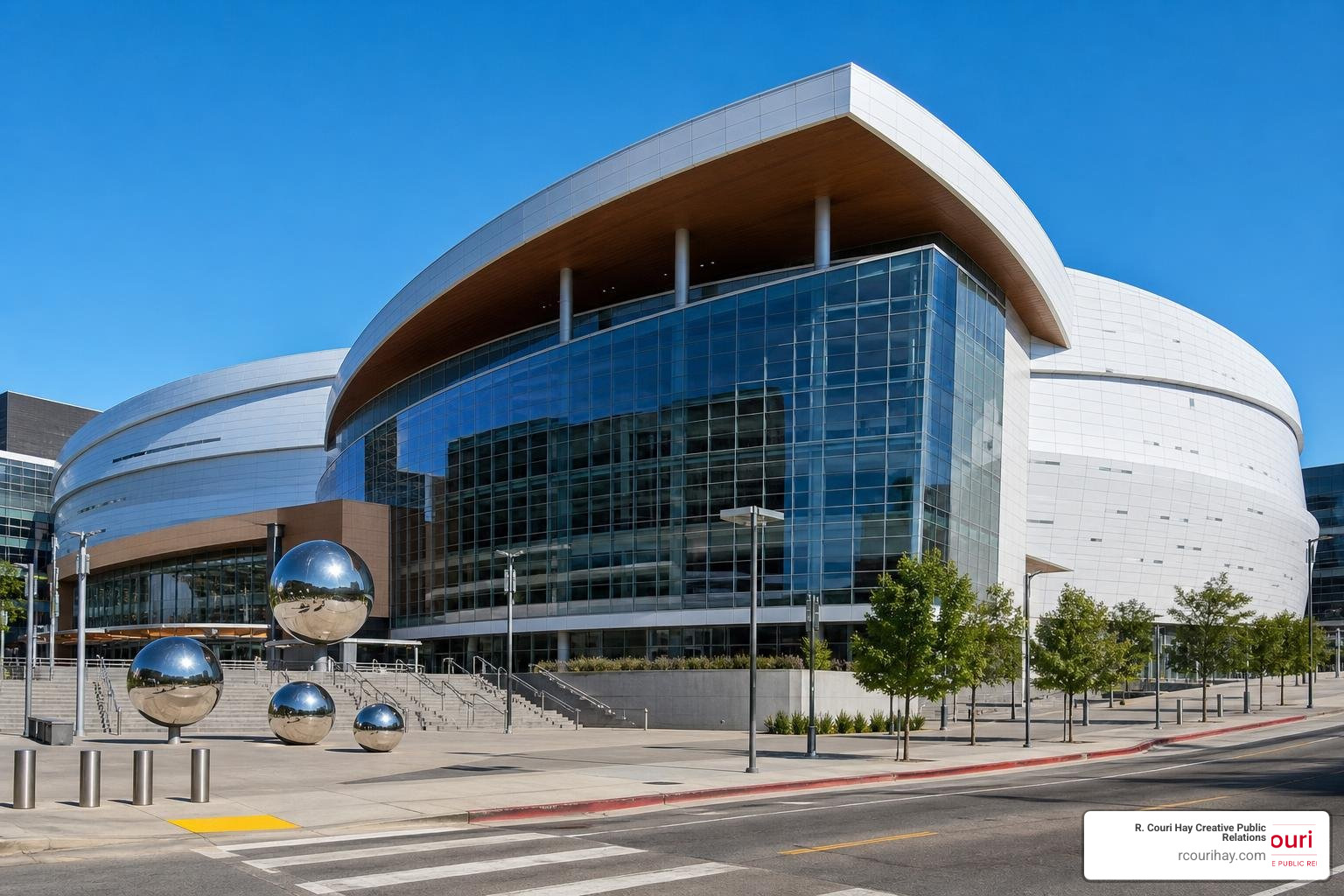
The crown jewel of this transition is Chase Center, a state-of-the-art arena located in the Mission Bay neighborhood of San Francisco. Opened in 2019, Chase Center brought the team back to San Francisco and created a new platform for basketball, concerts, corporate events, luxury suites, dining, and high-profile cultural moments.
On the basketball side, the team has continued to manage the challenge of maximizing the remaining championship window of Stephen Curry while developing younger players and adjusting to a changing Western Conference. That balance between legacy and reinvention is also a communications challenge: the franchise must honor its dynasty years while keeping fans, sponsors, media, and partners invested in what comes next.
Roster construction, injuries, salaries, and performance data change quickly, so readers should consult updated statistical sources when evaluating the team’s current competitive position. For a complete breakdown of season games, individual player salaries, and advanced metrics, view the 2025-26 Golden State Warriors Roster and Stats | Basketball-Reference.com database.
Daily coverage also shapes how the public perceives the franchise. A single regular-season result can become part of a wider conversation about expectations, pressure, aging stars, and organizational direction. For an example of how game coverage frames those narratives, read the full recap via Warriors lose to tanking team again — this time against the Bulls – AOL.
Franchise Rivalries and Brand Evolution
The Warriors‘ rise to global prominence has been shaped by rivalry, visual identity, and repeat appearances on the NBA’s biggest stages. These elements matter because rivalries are among the strongest storytelling tools in sports PR.
The team’s most intense modern rivalry was with the Cleveland Cavaliers. Between 2015 and 2018, the two teams met in four consecutive NBA Finals, the only time in league history two franchises have faced each other in four straight championship series. The matchup between Stephen Curry and LeBron James gave the league a clear narrative center and helped define an era of basketball conversation.
The Warriors also maintain natural Pacific Division rivalries with the Los Angeles Lakers and the Sacramento Kings. The Lakers bring history, celebrity, and Los Angeles media gravity. The Kings bring a Northern California edge that has grown more intense through competitive playoff and regular-season matchups.
The franchise’s visual identity has also evolved dramatically. From the classic The City logo featuring the Golden Gate Bridge in the 1960s, to the blue-and-orange Thunder mascot era of the late 1990s, to the modern blue-and-gold Bay Bridge identity, the Warriors have repeatedly used design to connect place, nostalgia, and contemporary relevance.
For a luxury and lifestyle communications audience, this is a useful lesson: heritage branding works best when it is not frozen in the past. The Warriors have succeeded by continually reinterpreting their history for new fans, new media formats, new merchandise, and new cultural moments.
Frequently Asked Questions about the Warriors
These questions cover the most common fan queries while also highlighting why the Warriors are relevant as a sports brand, media property, and public relations case study.
How many championships have the Warriors won?
The Warriors have won 7 NBA championships. Their title-winning seasons occurred in 1947 and 1956 as the Philadelphia Warriors, and in 1975, 2015, 2017, 2018, and 2022 as the franchise later known as the Golden State Warriors.
Those championships give the organization a strong heritage platform for media storytelling, anniversary content, player legacy campaigns, and fan engagement.
Who is the all-time leading scorer for the franchise?
Stephen Curry is the franchise’s all-time leading scorer. He is also the central figure in the modern Warriors dynasty and one of the most influential athletes in the history of basketball.
From a communications perspective, Curry’s value extends beyond statistics. His shooting style, public image, leadership, family-friendly appeal, and global recognition have helped make the Warriors one of the NBA’s most visible brands.
Where do the Warriors play their home games?
The Warriors play their home games at Chase Center, located in the Mission Bay neighborhood of San Francisco, California. The arena opened in September 2019, marking the franchise’s return to San Francisco after many years in Oakland.
Chase Center is important not only as a basketball venue but also as a luxury hospitality, entertainment, sponsorship, and live-event platform.
Conclusion
The Warriors represent more than a basketball team. They are a case study in how performance, personality, place, design, venue strategy, media narrative, and fan loyalty can turn a sports franchise into a global cultural brand.
From their beginnings in Philadelphia to their modern era at Chase Center in San Francisco, the franchise has repeatedly shown the value of reinvention. Championships created credibility. Stars created visibility. Rivalries created drama. Chase Center created a premium lifestyle platform. Together, those pieces built a brand that reaches sports fans, celebrities, sponsors, luxury audiences, and global media.
At R. Couri Hay Creative Public Relations, we understand the power of building an iconic public image. Operating in premier cultural hubs including New York City, Southampton, Los Angeles, Palm Beach, Aspen, London, and Paris, our team specializes in crafting narratives that capture luxury living, wealth, success, art, society, and high-profile lifestyle stories.
Just as the Warriors redefined basketball through vision, teamwork, and cultural relevance, we help clients shape stories that earn attention and endure. To stay connected with the worlds of luxury, high society, and elite lifestyle trends, Read the latest gossip and lifestyle news.