

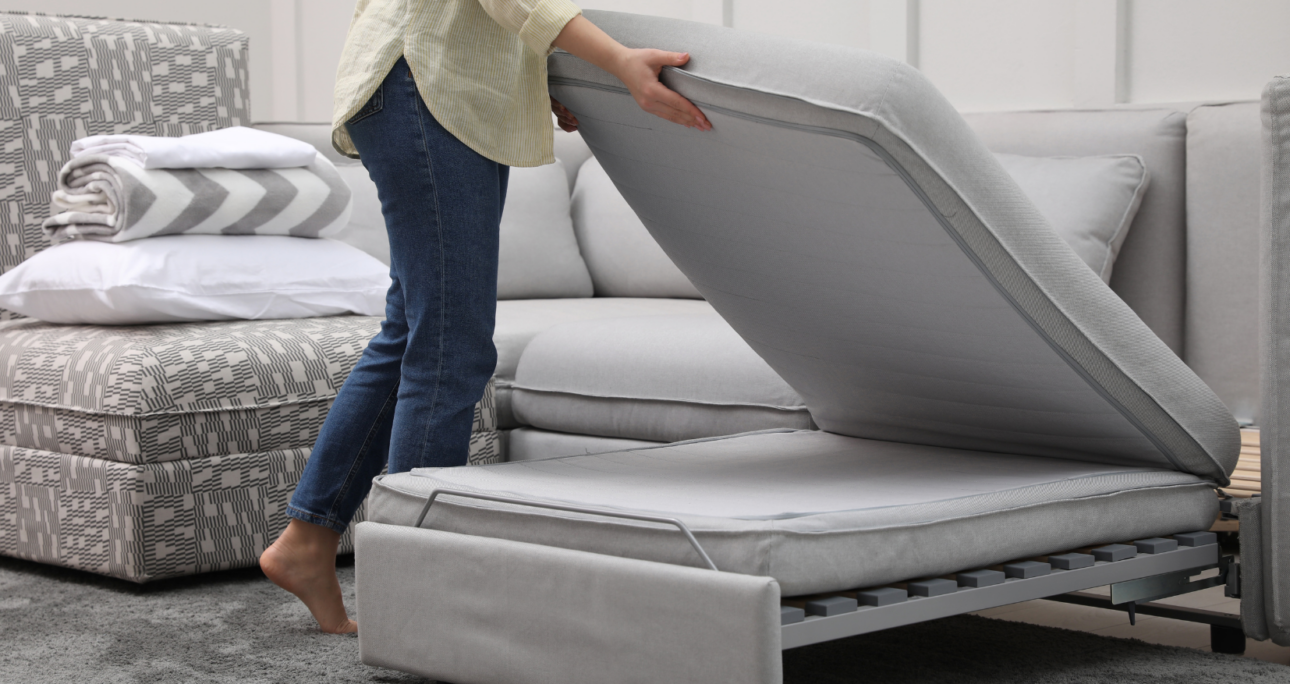
Most people test a convertible sofa once in the showroom. They pull the frame forward, fold it back in, and assume the motion they felt will hold up over time. What they are really testing is a brand-new mechanism under zero fatigue.
Failure timing is rarely random. It follows the quality of the moving parts underneath.
A fixed sofa depends mainly on its frame and suspension. Convertible designs introduce hinges, pivots, springs, and sliding tracks. Each component adds friction points. The number of cycles those parts endure determines how long the piece performs as intended.
Steel Gauge and Structural Flex
The thickness of the steel used in a mechanism makes a difference that most buyers never see. Thinner metal reduces cost and weight, but it also increases flex under load.
When a sleeper mechanism unfolds, weight shifts toward the front. If the steel frame flexes slightly during use, that movement repeats every time the bed is opened and closed. Over months, small flex patterns create alignment drift.
At first, the shift is subtle. The bed may require slightly more effort to pull out. Later, joints begin to misalign. The mechanism does not fail all at once. It tightens, sticks, or develops uneven movement before it breaks.
Higher gauge steel resists that drift. Less flex means less cumulative stress at connection points.
Joint Design and Wear Patterns
Mechanisms rely on pivot points. Those pivots are either reinforced or lightly pinned together.
Lower-cost builds may use simpler fasteners that perform adequately in early use. Repeated motion wears down contact areas. Small gaps form. Movement becomes less smooth.
Over time, users compensate by pulling harder or applying uneven force. That extra strain accelerates wear at the weakest joint.
In higher-quality mechanisms, pivot points are reinforced to distribute pressure more evenly. Bushings or protected joints reduce metal-on-metal friction. The opening motion remains consistent longer because stress is absorbed.
Spring Tension and Return Balance
Convertible systems often include springs to assist with lifting and closing. Those springs are calibrated to counterbalance weight.
If spring tension is too low, users exert more effort during operation. That added force transfers to hinges and rails. If tension is too high, the mechanism may snap back aggressively, placing stress on anchor points.
Over time, springs lose elasticity. In lower-quality systems, that loss happens faster. As tension declines, the mechanism shifts from balanced to strained. The change is gradual. The bed may feel heavier to lift than it did when new.
Better-built systems use springs rated for higher cycle counts, reducing performance drop-off.
Rail Alignment and Floor Contact
Mechanisms often rely on rails that extend outward before unfolding. If those rails are not precisely aligned during manufacturing, friction increases.
Early in ownership, the motion may feel slightly rough but manageable. As surfaces wear unevenly, resistance grows. Users apply more force. Minor misalignment becomes more pronounced.
In designs like sofa beds, where repeated folding places pressure on consistent track paths, alignment precision determines long-term smoothness. Poor alignment does not just affect ease of use. It accelerates structural fatigue.
Weight Distribution and Mattress Support
Mechanism quality also influences how weight distributes when used as a bed. If the support bars beneath the mattress are spaced too widely or made from lighter material, sag can develop in the center.
This sag places uneven strain on connecting joints. Instead of distributing weight across multiple support points, pressure concentrates in fewer areas.
Over years, this uneven load shortens the life of both the mechanism and the mattress platform.
Cycle Counts and Realistic Use
Manufacturers often test mechanisms for a certain number of open-close cycles. The real question is how those tests compare to household patterns.
A guest room sleeper may be opened a few dozen times per year. A primary living space sleeper may be used weekly. Mechanisms built for light occasional use may show fatigue quickly under frequent operation.
Failure timing aligns closely with cycle rating. Higher-rated systems degrade more slowly under consistent use. Lower-rated ones may show play or stiffness within a shorter period.
Convertible sofas introduce complexity beneath the upholstery. The visible surface may remain intact while the mechanism underneath begins to strain.
Steel gauge, pivot reinforcement, spring calibration, alignment precision, and weight distribution all influence how long the system operates smoothly. The first few months rarely reveal weaknesses. Repetition does.
Also read:Creating a Home That Feels Collected, Warm, and Intentional With This Luxury Brand