

What Is Triangle of Sadness? The Award-Winning Satire Explained
Triangle of Sadness is a 2022 black comedy film written and directed by Swedish filmmaker Ruben Östlund. It won the Palme d’Or at the 75th Cannes Film Festival — the highest prize in world cinema — and earned three Academy Award nominations, including Best Picture.
Here are the key facts at a glance:
| Detail | Info |
|---|---|
| Director | Ruben Östlund |
| Release Year | 2022 |
| Genre | Satirical Black Comedy |
| Runtime | 147 minutes |
| Major Award | Palme d’Or, Cannes 2022 |
| Oscar Nominations | Best Picture, Best Director, Best Original Screenplay |
| Box Office | $32.9M worldwide on a $15.6M budget |
| Streaming | Available on Netflix |
| Rotten Tomatoes | 72% critics / 80% audience |
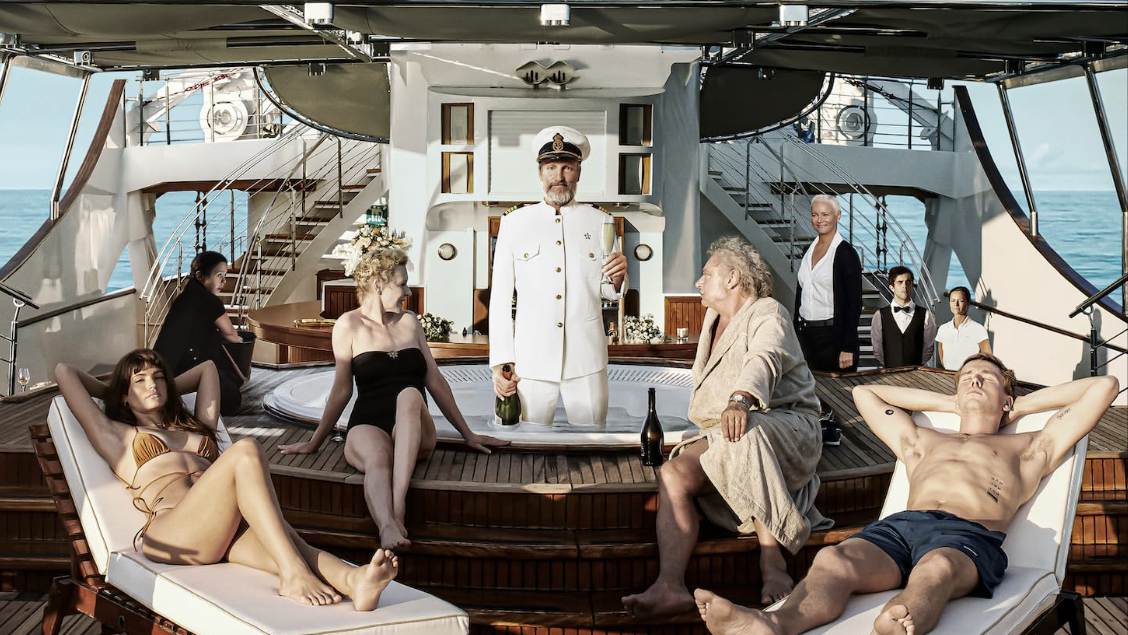
The film follows a celebrity model couple who join a luxury cruise packed with the ultra-wealthy. When disaster strikes, the survivors wash up on a deserted island — and everything they thought gave them power suddenly means nothing.
It’s a sharp, often stomach-churning satire about wealth, beauty, and who really holds power when money stops working.
The story unfolds in three distinct acts. First, we meet models Carl and Yaya navigating the transactional world of fashion and relationships. Then the action moves to a superyacht, where the ultra-rich collide with their service staff during a catastrophic storm. Finally, the survivors land on an island where a toilet cleaner becomes the most powerful person alive.
The film received an eight-minute standing ovation at Cannes — a sign of just how deeply it struck a nerve.
The Visionary Behind the Satire: Ruben Östlund
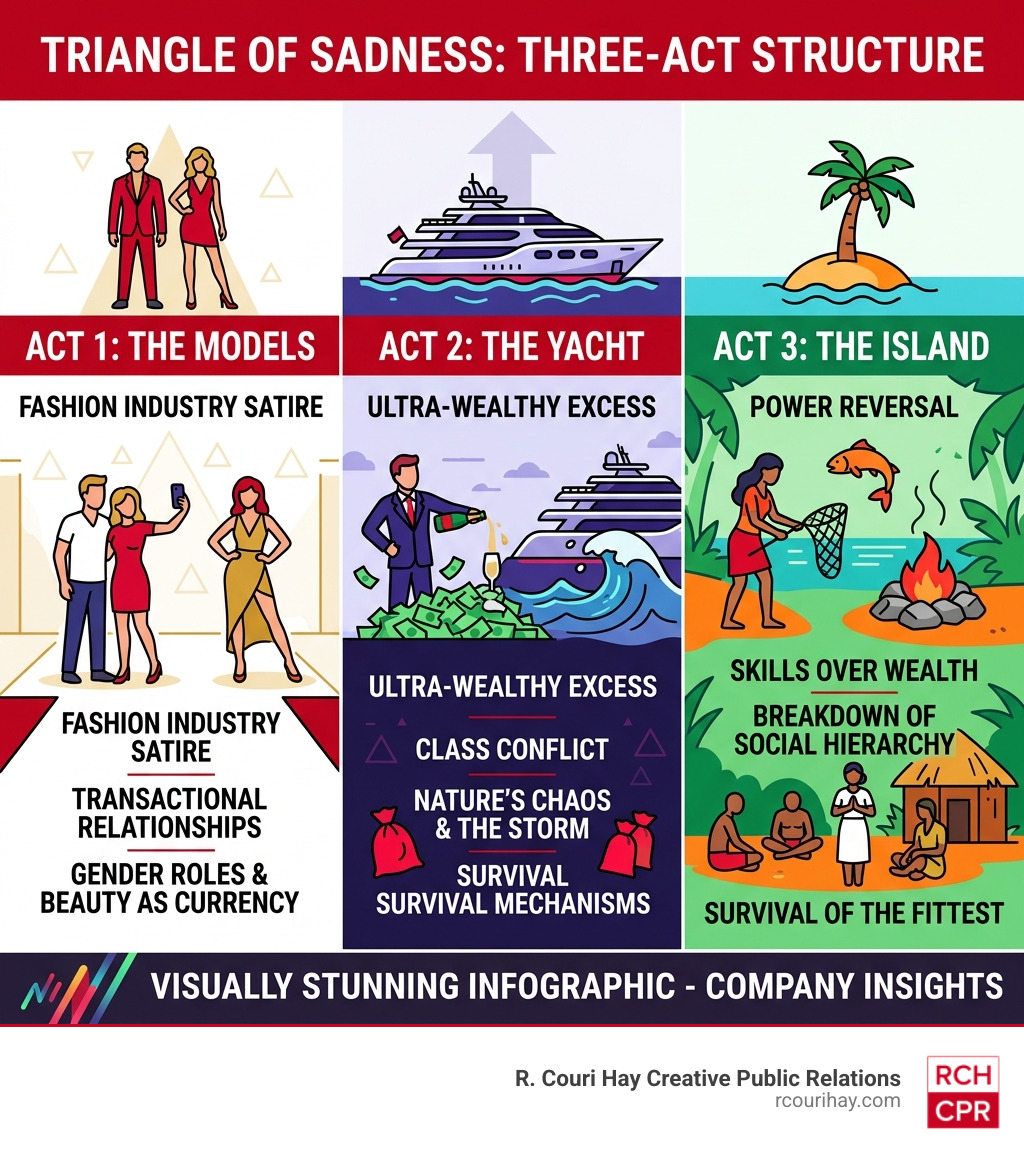
When we look at the landscape of modern cinema, few directors capture the awkwardness of human social structures quite like Ruben Östlund. As we move through 2026, his work remains a benchmark for “cringe comedy” that actually has something profound to say. Östlund is a rare breed in the film world; he is one of the few directors to win the prestigious Palme d’Or twice.
His first win came for The Square (2017), which skewered the high-art world. Before that, he gained international acclaim for Force Majeure (2014), a chilling look at masculinity and family dynamics. With triangle of sadness, Östlund made his English-language debut, bringing his signature style to a much broader, global audience.
According to Triangle of Sadness – Wikipedia , Östlund’s approach is rooted in long, uncomfortable scenes that force us to confront our own biases. He doesn’t just want to tell a story; he wants us to squirm in our seats. This “social cringe” is his specialty, and it’s what makes the film so memorable for audiences in cultural hubs from New York City to Paris.
Production Challenges and Filming Locations
Creating a masterpiece like triangle of sadness was no easy feat, especially given the timing. The production faced significant hurdles due to the COVID-19 pandemic. To keep the cameras rolling, the team conducted a staggering 1,061 COVID tests — all of which came back negative. This level of dedication ensured that the 73-day shoot could be completed across stunning locations in Greece and Sweden.
One of the most authentic elements of the film is the yacht itself. The production used the Christina O, a legendary vessel formerly owned by Aristotle Onassis. This choice added a layer of historical weight to the satire; this was a real-world playground for the ultra-wealthy, now being used to dismantle the very idea of inherited status.
Östlund is also famous for his rigorous directing style. He often demands an unusually high number of takes — sometimes up to 23 per scene. He pushes his actors until the “performance” falls away, leaving something raw and painfully real. This perfectionism is clearly visible in every frame of the final 147-minute runtime.
Breaking Down the Triangle of Sadness Plot
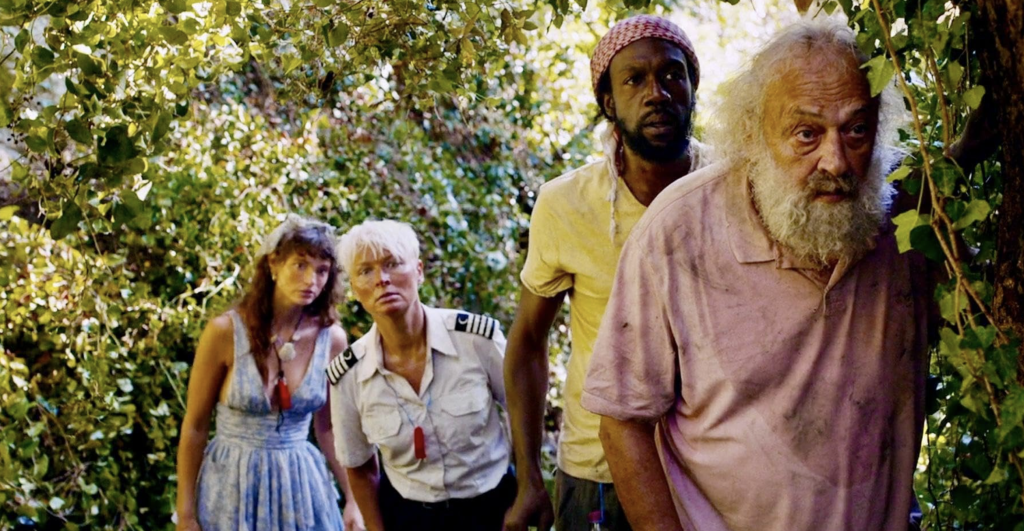
The film is meticulously divided into a three-act structure, a choice that allows the audience to see the characters in three completely different social environments. As noted on Triangle of Sadness (2022) – IMDb , this structure is vital for the film’s message about the fluidity of power.
Part 1: Carl & Yaya
The story begins in the fashion world. Carl and Yaya are a celebrity model couple whose relationship is as much a business transaction as it is a romance. We see them argue over a dinner bill — a scene that perfectly captures the tension between modern gender roles and financial expectations. In this world, “beauty is currency,” and Yaya knows how to spend hers better than Carl does.
Part 2: The Yacht
The couple is invited on a $250 million luxury cruise, populated by Russian oligarchs, British arms dealers, and tech millionaires. Here, the social hierarchy is rigid: the wealthy are at the top, the service staff are in the middle, and the cleaning crew (mostly people of color) are hidden in the bowels of the ship. This act is defined by the “In den Wolken” (In the clouds) mentality of the guests, who are completely detached from the reality of the labor that supports their lifestyle.
Part 3: The Island
After a pirate attack and a catastrophic storm, a small group of survivors is stranded on a deserted island. Suddenly, the millions of dollars in the guests’ bank accounts are worthless. The hierarchy flips overnight. Abigail, the ship’s “toilet manager,” is the only one who knows how to build a fire and catch fish. In this new meritocracy, she becomes the “Captain,” and the wealthy guests must serve her to survive.
The Infamous Vomit Scene and the Captain’s Dinner
If there is one thing everyone remembers about triangle of sadness, it’s the “vomit scene.” During the Captain’s Dinner, a violent storm hits. As the yacht tosses and turns, the guests — who are busy consuming “squid emulsion” and other delicacies — begin to succumb to extreme seasickness.
What follows is a prolonged, graphic, and hysterically chaotic sequence of bodily fluids. Woody Harrelson, playing the alcoholic, Marxist captain, stays in the dining room with a Russian capitalist oligarch (Zlatko Burić). While the ship literally falls apart and the guests descend into physical misery, the two men get drunk and trade quotes about communism and capitalism over the ship’s intercom.
This scene is significant because it represents the total collapse of social decorum. The “beautiful people” are reduced to their most basic, uncontrollable biological functions. It’s a moment of cinematic catharsis where the “eat the rich” theme becomes literal and messy.
Interpreting the Ambiguous Ending of Triangle of Sadness
The film’s ending has sparked endless debate in screening rooms from London to Los Angeles. After spending time as the de facto leader of the island, Abigail discovers a luxury resort hidden on the other side of the hill. She realizes that their “survival” was just a few miles away from civilization.
Yaya, excited by the discovery, offers to help Abigail find a job back in the real world. However, Abigail realizes that once they return to society, she will go back to being a “nobody,” while Yaya will return to her life of privilege. The film cuts away just as Abigail approaches Yaya from behind with a heavy rock.
The final shot shows Carl sprinting through the jungle. Is he running to save Yaya? Or is he running because he senses the shift in the air? The ambiguity leaves the audience to decide: does power always corrupt, regardless of who holds it?
Themes of Wealth, Beauty, and Class Satire
At its heart, triangle of sadness is an exploration of “appearance as capital.” In the first act, we see that being beautiful allows Carl and Yaya to enter spaces they couldn’t otherwise afford. However, the film argues that this form of capital is just as fragile as a bank account.
The phrase “In den Wolken” (In the clouds) is repeated by a character who has suffered a stroke and can only speak those few words. It serves as a haunting metaphor for the elite guests who live their lives above the “storm” of reality until it finally crashes down on them.
| Feature | The Yacht (Old World) | The Island (New World) |
|---|---|---|
| Leader | The Captain (Woody Harrelson) | Abigail (Dolly De Leon) |
| Currency | Money & Social Media Followers | Food & Survival Skills |
| Status Symbol | Rolex Watches & Couture | Pretzels & Fresh Fish |
| Gender Roles | Traditional / Transactional | Fluid / Based on Utility |
Comparing Triangle of Sadness to The White Lotus and Parasite
The early 2020s saw a massive surge in the “eat the rich” genre. triangle of sadness is often compared to the HBO hit The White Lotus and the Oscar-winning Parasite. While all three explore class warfare, they do so with different tones.
- Parasite is a tense, clockwork thriller about the desperation of the working class.
- The White Lotus is a character-driven study of the oblivious cruelty of the wealthy.
- triangle of sadness is more of a “bludgeoning” satire. It uses gross-out humor and absurd role reversals to make its point. It is less concerned with subtlety and more focused on the visceral experience of social collapse.
Critical Reception, Awards, and Box Office Success
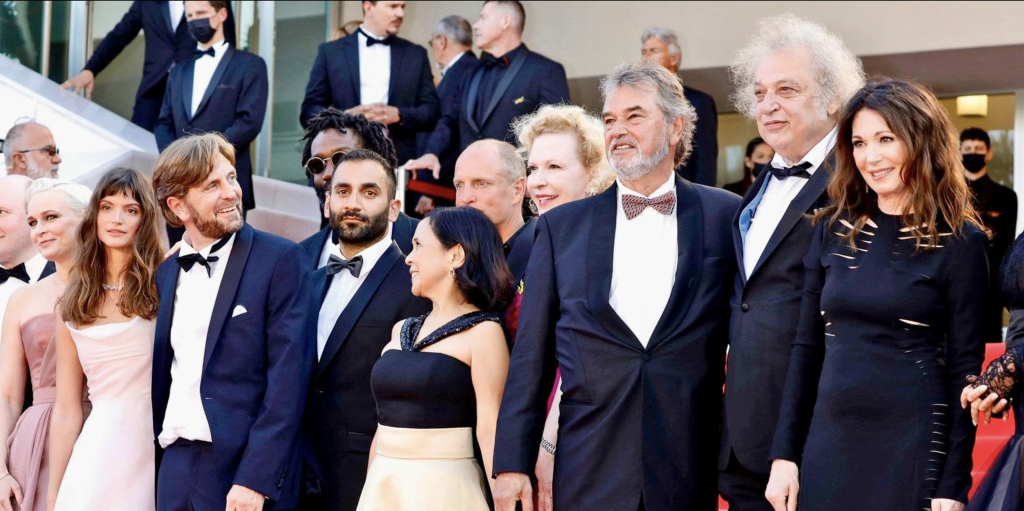
The film was a darling of the 2022-2023 awards season. Beyond the Palme d’Or, it earned three major Academy Award nominations: Best Picture, Best Director, and Best Original Screenplay. This was a massive achievement for an independent, European-led production.
The statistics speak for themselves:
- Box Office: It grossed $32.9 million worldwide against a $15.6 million budget.
- European Success: It sold over 2 million tickets across Europe, proving that high-concept satire can still draw a crowd.
- Critical Scores: It holds a 72% Tomatometer score on Rotten Tomatoes and a 63/100 on Metacritic, indicating “generally favorable” reviews.
While some critics, like those at The New Yorker, found the film to be “targeted demagogy,” others, like filmmaker Edgar Wright, praised it as a “purely theatrical experience.”
The Stellar Cast and Standout Performances
The ensemble cast is one of the film’s greatest strengths.
- Harris Dickinson (Carl): Dickinson brings a perfect blend of vanity and vulnerability to the role of a male model struggling with his place in the world.
- Charlbi Dean (Yaya): Dean’s performance is captivating. Tragically, she passed away shortly before the film’s release, making this her final and perhaps most brilliant role.
- Woody Harrelson (The Captain): Harrelson is perfectly cast as the cynical, Marxist captain who has given up on the world.
- Dolly De Leon (Abigail): The true breakout star of the film. Her transition from a quiet cleaning lady to a ruthless, pragmatic leader is the emotional and thematic anchor of the third act.
Frequently Asked Questions about Triangle of Sadness
What does the title “Triangle of Sadness” actually mean?
The title is a technical term used in the fashion and plastic surgery industries. It refers to the “worry wrinkle” between the eyebrows. In the film’s opening scene, a casting director tells Carl to “relax his triangle of sadness.” It symbolizes the superficiality of an industry where even a tiny facial muscle can determine your value.
Where can I stream the movie in 2026?
As of May 2026, triangle of sadness is widely available for streaming. You can find it on Netflix, where it remains a popular choice for fans of independent cinema. It is also available via the Criterion Collection for those who want to dive into the special features and director’s commentary. You can also rent or buy it on digital platforms like VOD and iTunes.
Is the film considered a masterpiece of modern satire?
While “masterpiece” is a subjective term, the film’s win at Cannes and its three Oscar nominations certainly put it in the top tier of 21st-century satire. Its ability to spark conversation about wealth inequality and gender roles — while making audiences both laugh and gag — ensures its place in the cinematic canon.
Conclusion
At R. Couri Hay Creative Public Relations, we are constantly observing the intersection of luxury, status, and social commentary. Triangle of Sadness serves as a fascinating, if exaggerated, look at the worlds we navigate every day in New York, Palm Beach, and London. It reminds us that while beauty and wealth are powerful tools, they are ultimately subject to the whims of nature and the resilience of the human spirit.
Whether you’re a fan of Ruben Östlund’s previous work or just looking for a movie that will keep you talking for days, this film is essential viewing. It challenges us to look past the “triangle of sadness” on our own faces and consider what truly matters when the yacht starts to sink.