


Artificial intelligence in 2026 is no longer a boardroom experiment or a novelty feature added to a product roadmap. It has become a commercial layer sitting underneath search, customer service, software development, marketing, entertainment, education and, increasingly, personal relationships. The market is still full of hype, but the direction is clearer than it was two years ago: businesses want measurable productivity gains, while consumers want AI that feels useful, immediate and personal.
The most important shift is that AI is moving from “tool” to “interface.” People are not only using AI to write a paragraph or generate a picture. They are using it to ask questions, compare products, plan trips, manage work, learn skills, create content, roleplay, receive emotional support and build private digital routines. For companies, that changes the opportunity. AI is no longer only about automation. It is about becoming the place where users begin a task.
That is why 2026 should be viewed through two lenses. The first is enterprise AI: agents, workflow automation, model governance, data infrastructure and measurable return on investment. The second is consumer AI: search, entertainment, creativity, AI companions and the demand for more personalised digital interaction.
Both sides are growing fast. They are also becoming more difficult to manage.
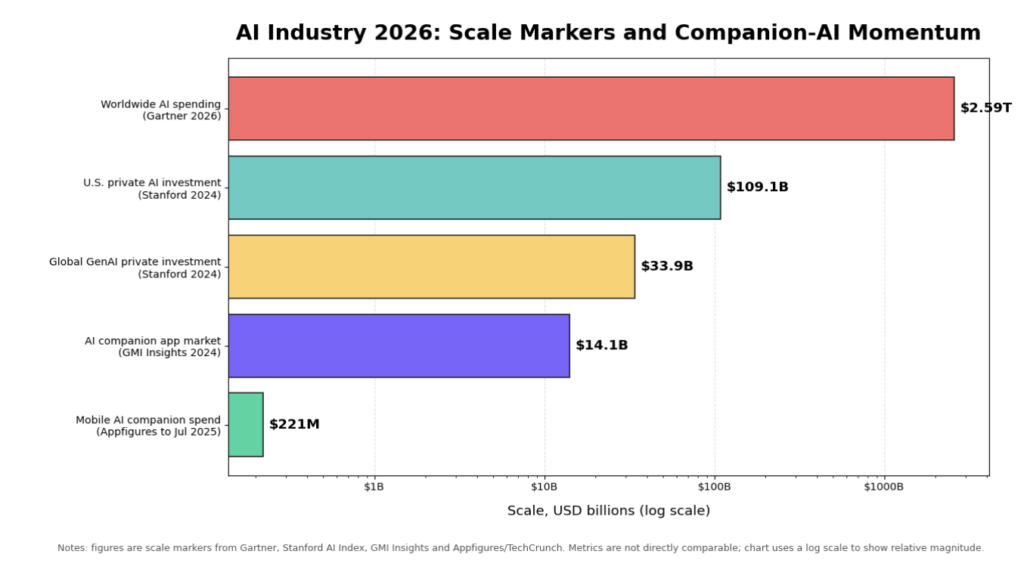
Key Market Signals for 2026
| Trend Area | United States | United Kingdom | Business Implication |
| AI investment | The U.S. remains the global leader in private AI funding | The UK is smaller but strategically important in fintech, compliance, safety and applied AI | Capital is concentrated in the U.S., but trusted AI products can scale strongly in the UK |
| Enterprise adoption | Fast movement into agents, copilots, coding tools and customer operations | More cautious adoption, especially in regulated sectors | UK buyers may move slower, but they value governance and transparency |
| AI search | Users are shifting from keyword search to conversational answers | Google remains dominant, but AI summaries and ChatGPT usage are rising | Brands need visibility inside AI-generated answers, not only search rankings |
| Generative AI at work | Content, coding, sales, support and internal knowledge tools are mainstreaming | NLP and text generation are leading use cases among AI adopters | AI must be connected to workflows, not left as a generic chatbot |
| AI companions | Strong demand for character chat, roleplay, girlfriend/boyfriend apps and adult AI | Growing demand, but with stronger focus on privacy, online safety and age checks | Companion AI is commercially attractive but ethically sensitive |
1. AI Spending Is Big, But ROI Is Under Pressure
The AI industry is entering a more disciplined phase. Spending is huge, but companies are becoming less patient with vague promises. A few years ago, it was enough for a vendor to demonstrate a chatbot that could summarise a document or write a sales email. In 2026, that is not enough. Executives want to know whether AI shortens support queues, reduces manual review, improves conversion, speeds up engineering, lowers fraud or helps employees make better decisions.
This is the new divide in the market. On one side are companies buying AI because they fear being left behind. On the other side are companies integrating AI into real operating processes. The second group will create more durable value.
The best enterprise use cases are not glamorous. They are practical: claims processing, call-centre triage, CRM updates, proposal drafting, legal document review, code completion, knowledge retrieval, internal reporting and compliance monitoring. These are not “AI magic” stories. They are workflow stories.
The businesses that win in 2026 will not be the ones with the loudest AI branding. They will be the ones that connect AI to data, process, governance and measurable outcomes.
2. AI Agents Are Moving From Demo to Deployment
The phrase “AI agent” has been overused, but the underlying trend is real. Companies no longer want systems that merely answer a question. They want software that can take action.
A basic chatbot says, “Here is what the customer asked.” An AI agent can read the customer request, check the knowledge base, classify the issue, draft a reply, update the ticket, flag a refund risk and notify a supervisor. In sales, an agent may research a prospect, write a personalised message, log the interaction and schedule a follow-up. In finance, it may compare invoices, detect anomalies and prepare a report for review.
This matters because it moves AI from communication into execution.
The United States is likely to remain ahead in agent deployment because of its cloud infrastructure, startup ecosystem and enterprise software budgets. The UK may adopt more carefully, particularly in finance, insurance, healthcare, education and legal services. That caution is not necessarily negative. In regulated industries, “safe enough to deploy” is more valuable than “impressive in a demo.”
The agent market in 2026 will be judged by reliability. If an AI agent saves five minutes but creates ten minutes of correction work, it is not an agent. It is noise.
3. AI Search Is Changing What Users Expect
One of the biggest consumer shifts is the move from search engines to answer engines. People are no longer typing only short queries. They are asking full questions and expecting structured answers.
A user does not search “best CRM small business” anymore. They ask: “Compare affordable CRM tools for a ten-person agency with email automation, UK support and low setup time.” A traveller does not search ten separate pages for a weekend plan. They ask for a personalised itinerary based on budget, location, food preferences and weather.
This behaviour is changing digital marketing. SEO still matters, but it is no longer the whole game. Businesses now need to think about how their products, reviews, brand mentions and authority signals appear inside AI-generated answers. The next marketing discipline is not just search optimisation. It is answer optimisation.
In the U.S., users are comfortable moving between ChatGPT, Gemini, Claude, Perplexity, Copilot and AI-enhanced search. In the UK, Google remains dominant, but AI summaries and generative search experiences are becoming part of everyday browsing. For brands, the message is simple: if AI becomes the front door to information, being invisible to AI systems becomes a commercial risk.
4. What People Are Searching For
Consumer demand in 2026 is practical, emotional and increasingly specific. People are not only asking “What is AI?” They are asking how AI can save time, make money, improve work, entertain them or give them a more personal digital experience.
| Search Intent | Typical User Need | Commercial Opportunity |
| “Best AI tools for work” | Save time on writing, meetings, research and admin | Productivity suites, copilots, workflow tools |
| “AI coding assistant” | Build, debug and ship software faster | Developer tools, code agents, testing automation |
| “AI image/video generator” | Create ads, social content, design assets and videos | Creative platforms, marketing tools |
| “AI search engine” | Get faster, clearer answers than traditional search | Answer engines, research assistants |
| “AI agents for sales” | Automate prospecting, CRM updates and follow-up | Sales enablement platforms |
| “AI privacy risks” | Understand what happens to data | Security, compliance and privacy-first tools |
| “AI girlfriend / AI companion” | Private chat, fantasy, roleplay, emotional interaction | Companion apps, adult AI, character platforms |
| “AI tools for small business” | Reduce workload without hiring more staff | SMB automation, accounting, support tools |
| “How to use AI safely” | Avoid scams, data leaks and hallucinations | Training, governance, responsible AI services |
This mix is important. The AI market is not only a productivity market. It is also becoming an entertainment market, a search market and a personal interaction market.
5. Generative AI Is Becoming Operational
The first wave of generative AI was about producing content. The next wave is about running processes.
Marketing teams use AI to create campaign variations, analyse performance and personalise messages. Customer support teams use it to summarise tickets, suggest replies and identify urgent cases. Software teams use AI coding assistants to accelerate development. HR teams use AI to draft job descriptions, analyse employee feedback and support training. Legal and compliance teams use AI to review documents, compare clauses and identify risk.
The common pattern is not replacement. It is acceleration.
The strongest implementations keep humans in the loop. AI drafts, but people approve. AI recommends, but managers decide. AI highlights patterns, but specialists interpret them. This is especially important in legal, medical, financial and employment contexts, where a confident but wrong answer can cause real harm.
In 2026, responsible AI is not a public relations phrase. It is an operational requirement.
6. AI Companions Are Becoming a Serious Consumer Category
One of the most commercially interesting parts of consumer AI is also one of the most sensitive: AI companionship.
AI companions are different from productivity chatbots. The user is not mainly looking for facts. They are looking for presence, tone, personality, fantasy, emotional rhythm and sometimes intimacy. That creates a very different product category.
The market includes character chat platforms, AI girlfriend and boyfriend apps, roleplay bots, emotional support companions, fantasy characters and adult AI chat services. These products compete not only with software tools, but with entertainment platforms, dating apps, social media, gaming and private messaging.
Services such as Joi’s wife AI companion https://joi.com/characters/wife-ai show where part of the market is heading: not generic chatbots, but personalised character-led experiences built around role, mood, conversational style and private interaction. A user in this category is not only asking AI for information. They may be looking for a familiar voice, a romantic fantasy, a playful partner or a controlled digital space that feels more responsive than dating apps or social media.
This is why AI companionship is both attractive and risky. The engagement can be deep. The willingness to pay can be strong. But the product touches privacy, emotional dependency, adult content, age verification and data protection.
In the U.S., this category is more openly commercial, with users already familiar with subscription apps, adult platforms and character-based entertainment. In the UK, demand is growing, but the regulatory conversation is sharper. Platforms need to think carefully about age assurance, billing transparency, deletion controls and safeguards for vulnerable users.
7. U.S. Demand: Speed, Scale and Subscription Behaviour
The U.S. AI market is faster, louder and more heavily funded. Consumers adopt new tools quickly, and companies are more willing to test paid AI products. The strongest categories include general AI assistants, coding tools, AI search, creative generation, business automation and companion platforms.
American users are especially attractive to AI companies because they are comfortable with subscriptions. If a product saves time, entertains, improves work output or creates emotional attachment, there is a clear path to monetisation.
That matters for AI companions. The U.S. market is likely to remain a major growth driver for girlfriend apps, character roleplay, adult AI experiences and personalised entertainment products. The category benefits from privacy, mobile-first behaviour and a large audience already used to paying for digital content.
The challenge is retention without manipulation. Companion platforms must avoid turning emotional engagement into exploitative design. The best products will be the ones that balance personalisation with user control.
8. UK Demand: Trust, Safety and Practical Value
The UK market is more cautious, but not less important. British users are adopting AI for work, study, writing, translation, search, admin, small business tasks and creative projects. Companies are interested in automation, but they tend to ask more questions about compliance, data handling and accountability.
This creates opportunities for AI vendors that can position themselves around trust. Privacy-first AI tools, regulated-sector assistants, education platforms, legal support products, small-business automation and safe consumer AI products all have room to grow.
For AI companions, the UK market will require a careful approach. Adult or romantic AI services will need clear age checks, transparent data policies, visible safety controls and honest billing. The UK’s online safety environment means platforms cannot treat adult AI chat as a grey area forever.
The commercial opportunity is still real. People want private, responsive digital experiences. But in the UK, trust may become the main differentiator.
9. The Biggest Risks in 2026
The AI industry’s growth comes with a long risk list: hallucinations, data leakage, copyright disputes, model bias, deepfakes, fraud, rising infrastructure costs, unclear ROI and shadow AI use by employees.
Enterprise buyers worry about governance. Consumers worry about privacy and manipulation. Regulators worry about harm, age access and accountability.
AI companions sit in the most sensitive part of this landscape. They are designed to feel personal. That makes them powerful, but it also raises difficult questions. What happens to intimate conversations? Can users delete their history? Are minors protected? Are vulnerable users being pushed into dependency? Are paid upgrades clear, or are they designed to exploit emotional attachment?
These questions will shape the next stage of the market.
Conclusion: AI Is Becoming a Behavioural Layer
The AI industry in 2026 is moving beyond novelty. Businesses are demanding operational value. Consumers are demanding personal value. The strongest products will not simply be the most advanced models. They will be the products that understand what users are really trying to do.
In enterprise, that means workflow, cost reduction, speed and governance. In consumer AI, it means search, creativity, entertainment and companionship. In both cases, the winning companies will build around real behaviour, not around technical demos.
The central trend is simple: AI is becoming part of everyday decision-making and everyday emotion. It helps people work, search, create, choose, talk and feel less alone.
That is the opportunity. It is also my responsibility.
Also Read: Netflix Buys Ben Affleck’s AI Production Company