

Val Kilmer left behind one of the most versatile and quietly influential filmographies of his generation. From Juilliard-trained stage actor to blockbuster leading man to a late-career figure whose story became as much about resilience as performance, Kilmer’s career resists easy summary. This timeline traces the key moments that defined his life and work, and the legacy he left behind after his death in April 2025.
1959–1981: The Making of an Actor
Val Edward Kilmer was born on December 31, 1959, in Los Angeles, California. He showed an early talent for performance and was accepted into Juilliard’s drama program as one of the youngest students admitted at the time. His formal theater training set him apart from many of his future Hollywood peers, giving him a classical foundation that would show up throughout his career, even in his most commercial roles.
1983–1985: Stage Beginnings and a Breakout Film Debut
Kilmer’s professional debut came on Broadway in 1983, in a production of a working-class drama. He also performed in Shakespearean theater early in his career, honing a range that went far beyond the action-hero image he would later become known for. His film career began in 1984 with the Cold War satire Top Secret!, a comedic parody that showcased his willingness to embrace absurdity, a trait that would resurface throughout his career.
1986: Top Gun and Instant Stardom
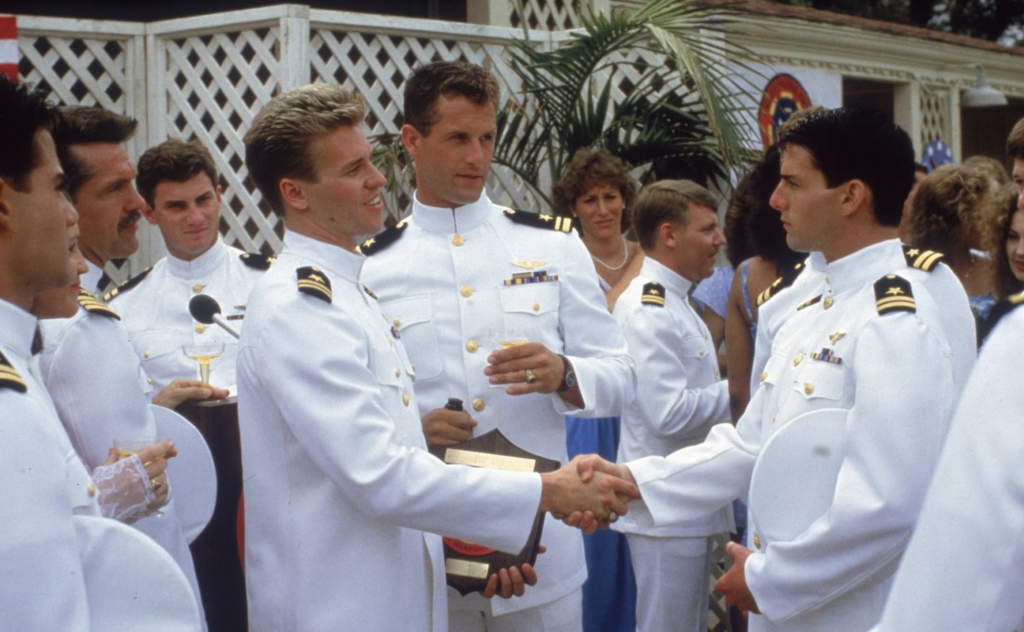
Kilmer’s role as Tom “Iceman” Kazansky in 1986’s Top Gun turned him into a household name almost overnight. As Maverick’s icy rival, Kilmer brought a controlled intensity to the role that made Iceman one of the film’s most memorable characters despite limited screen time. The film’s massive success launched Kilmer into a new tier of Hollywood stardom.
Early 1990s: A Run of Iconic Roles
The years that followed cemented Kilmer as one of the most versatile leading men of his generation. He took on the demanding role of Jim Morrison in Oliver Stone’s The Doors (1991), a performance widely praised for its physical and vocal transformation. He followed it with the role of Doc Holliday in Tombstone (1993), a performance many critics and fans still consider one of the finest supporting turns in the Western genre, quotable, tragic, and magnetic in equal measure.
Mid-1990s: Batman and Blockbuster Peak
In 1995, Kilmer took on the title role in Batman Forever, joining the small club of actors to portray the character on the big screen. While he stepped away from the franchise after a single film, the role placed him firmly among the era’s biggest box-office draws and remains one of the most talked-about entries in his filmography, both for its campy style and Kilmer’s performance within it.
Late 1990s–2000s: Range Over Repetition
Rather than chase another franchise lead, Kilmer spent the following years moving between genres, drama, thriller, comedy, and character work, often prioritizing interesting roles over box-office predictability. This period cemented a reputation among industry peers for genuine range, even as his mainstream visibility fluctuated compared to his mid-90s peak.
2014: A Cancer Diagnosis Changes Everything
In 2014, Kilmer was diagnosed with throat cancer. Treatment, including a tracheostomy, altered his voice significantly and required him to speak through an artificial device for much of the remainder of his life. Rather than retreat from public life entirely, Kilmer became remarkably open about his health struggles in the years that followed, reframing his relationship with his career and his audience.
2021: Val: A Raw, Self-Told Documentary
In 2021, Kilmer released Val, a deeply personal documentary built from decades of home footage he had filmed himself throughout his life and career. Narrated by his son, Jack Kilmer, the film offered an unusually intimate look at his rise to fame, his health battles, and his reflections on a career often defined by roles he didn’t get as much as the ones he did. The documentary premiered at Cannes and received widespread critical acclaim for its candor.
2022: One Last Flight as Iceman
Kilmer returned to the role that first made him famous in Top Gun: Maverick (2022), reprising Iceman more than three decades after the original film. Given his health circumstances, the production used voice technology to help recreate elements of his speech, and the emotional reunion between Kilmer and Tom Cruise’s Maverick became one of the most talked-about moments in the film, a fitting, full-circle appearance that would end up being his final theatrical role.
April 2025: Val Kilmer’s Death
Val Kilmer died on April 1, 2025, at the age of 65. His daughter, Mercedes Kilmer, confirmed that the cause of death was pneumonia, with his long history of throat cancer treatment cited as a contributing factor to his declining health in his final years. Tributes poured in from across Hollywood, including from longtime friend and Top Gun co-star Tom Cruise, underscoring the affection and respect Kilmer had earned across a four-decade career.
2026: A Posthumous Return, and a New Debate
Nearly a year after his death, Kilmer’s legacy took an unexpected turn. Filmmaker Coerte Voorhees revealed that Kilmer, cast years earlier in the historical drama As Deep as the Grave, had been too ill to ever film his role before he died. With cooperation from Kilmer’s estate and his daughter Mercedes, the production used generative AI technology to recreate his performance for the finished film, which debuted its trailer at CinemaCon in April 2026.
The decision sparked significant public debate. Supporters framed it as an extension of a project Kilmer had reportedly cared about deeply, tied to his Native American heritage and his connection to the American Southwest. Critics, however, questioned the ethics of using AI to generate a posthumous performance without the actor’s ability to consent to the specific execution, with online reaction split between calling the project a meaningful tribute and an uncomfortable precedent for the industry.
Why Val Kilmer’s Career Still Resonates
What set Kilmer apart from many of his blockbuster-era peers was his refusal to be boxed into a single type of role. He moved between rock biopic, Western legend, comic-book icon, and small character work with equal conviction, and his later willingness to be vulnerable about illness, first through Val, and later through the emotional weight of his Top Gun: Maverick return, added a layer of humanity to a career that had always been more textured than his most famous roles suggested.
Final Thoughts
Val Kilmer’s career timeline reads less like a straight line and more like a series of reinventions: teen heartthrob, dramatic chameleon, blockbuster leading man, and finally, a figure whose openness about illness reshaped how audiences saw him in his final years. Even after his passing, his legacy continues to generate conversation, a testament to a body of work and a life that never fit neatly into one category.