
For most of the past decade, style advice told women to keep jewelry small and discreet. Thin bands, tiny studs, a single fine chain. That advice is now out of date. As 2025 gave way to 2026, fashion swung from quiet minimalism toward maximalism, and jewelry moved from an afterthought to the centerpiece of an outfit. The engagement ring is part of that swing. Big stones and heavy settings are back, and the reason has more to do with clothing than with diamonds.
Maximalism follows a simple idea. More presence and more visible scale. On the runway and in street style that has meant stacked chains, oversized pendants, layered chokers, and chunky rings piled on several fingers. The look rewards jewelry that occupies space. An engagement ring built for that context needs size and weight, because a delicate solitaire disappears against a maximalist wardrobe.
The Return of Scale
Larger center stones are the most direct effect. Through the minimalist years, couples chose modest carat weights to fit the pared-back mood. The request has moved back toward stones that look substantial from across a room. A bigger diamond suits the maximalist rule of visible presence, and it balances the bold pieces a wearer stacks around it.
Scale also changed what counts as a normal proposal ring. A stone that once looked showy now looks current. This gives couples permission to buy the size they actually wanted, without the worry that a large ring would read as excessive. The fashion cycle has reset the baseline, and a substantial center stone now fits the moment rather than fighting it.
Geometry and the Square Stone
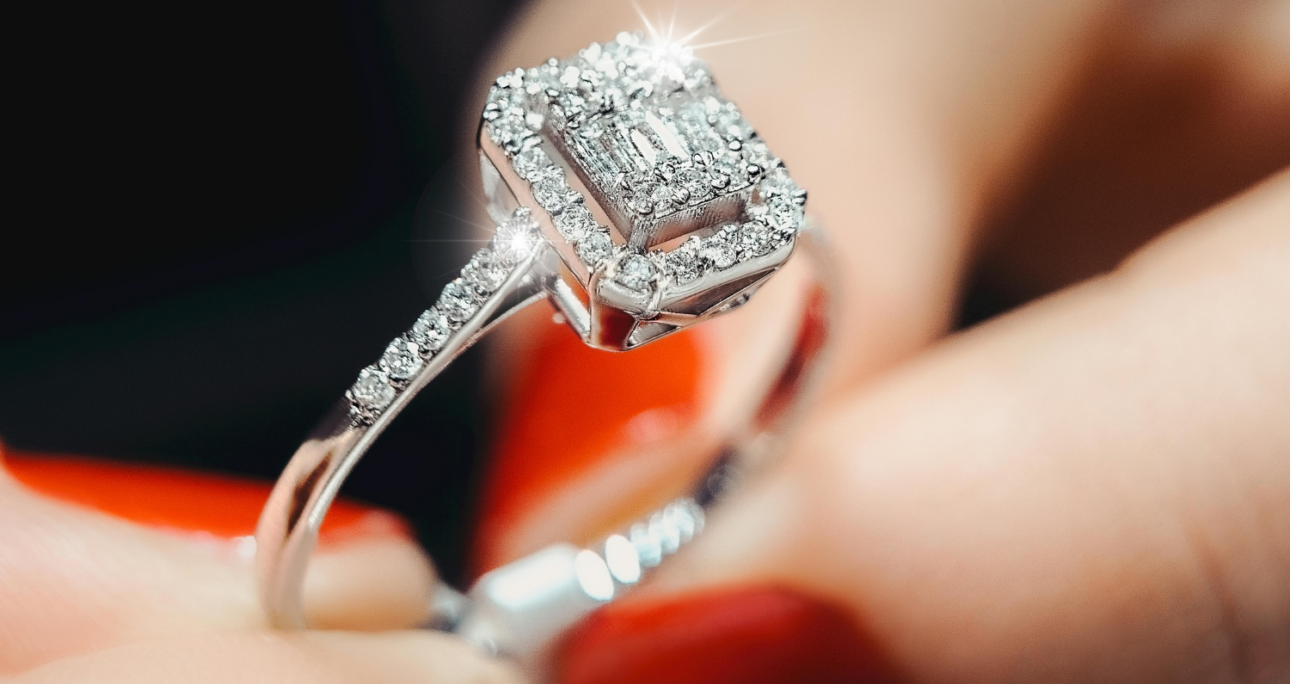
Maximalism favors shapes with hard edges and strong outlines, which is why square and geometric cuts suit the trend so well. A cushion, an emerald, an Asscher, or a princess cut diamond ring has the kind of bold, architectural face that a maximalist look calls for, and the sharp corners catch light and shadow in a way a soft round shape does not. These cuts also pair with the Art Deco geometry running through fashion, which gives the ring a period reference on top of its size.
The square stone answers a practical point too. A geometric cut fills more of the finger for its weight and gives a heavier setting a clean shape to frame. For a wearer who wants the ring to draw attention next to stacked bands and cuffs, a defined square face does that job better than a small round stone.
The Sculptural Setting
The band changed alongside the stone. Slim, almost invisible bands defined the minimalist years. Maximalism replaced them with chunky, sculptural settings that have real metal weight. A wide band has room for engraving, texture, or a row of side stones, and it balances a large center on the hand.
This matters for how the ring wears day to day. A heavier band is sturdier and less likely to bend, and it supports a big stone without the thin, fragile look of a knife-edge shank. The sculptural setting is part of the statement itself.
The Cultural Reason Behind It
The swing is generational as much as aesthetic. Maximalism is a reaction against the restraint of quiet luxury, and it is loudest among younger buyers.
For Gen Z buyers in particular, bold jewelry works as a way to show personality rather than status. The message of the trend is that a ring should say something specific about the wearer, and a large, distinctive piece does that more loudly than a discreet one. When a person layers heavy chains and stacks colorful cuffs, a small ring looks out of step, and a larger, more expressive ring matches the rest of what they wear.
A Note on Shape Data
Different cuts moved in different directions. Market data shows the princess cut, once a mainstream favorite, has declined in raw share, falling from about 12% to 6% of engagement ring sales as oval and other shapes took attention. That decline coincides with the maximalist move toward bold geometry, which suggests the two trends move independently. Size and weight are rising across the board, while the appeal of any single shape rises and falls on its own cycle. Emerald, oval, and cushion cuts have gained requests in the same period, so the square-stone revival is one part of a wider taste for bold outlines rather than a single shape winning out.
For a buyer, boldness matters more than picking whatever shape leads the chart this year. A geometric cut fits the maximalist look even when it does not top the sales ranking, and a shape that suits the wearer’s hand and taste will outlast the trend that made it popular.
Choosing an Oversized Ring Well
A large ring needs planning that a small one does not. The first question is proportion. A big stone should match the wearer’s hand and the scale of the jewelry they already wear, so the ring looks deliberate. The second is the setting. A heavier center needs a secure mount and a band wide enough for it.
Daily practicality still applies. A tall setting on a large stone catches on fabric and needs more frequent checks on its prongs. A lower, sturdier mount suits regular wear better and fits a person who rarely takes the ring off. For most buyers, a bold square stone in a low, heavy setting is the practical pick, delivering the presence the trend rewards without the extra care a tall, delicate mount demands.
A future season will likely pull jewelry back toward restraint, but a large, well-made ring outlives that turn on its own merits, since scale and craftsmanship keep their value after the look that made them current has moved on. The advice that once told women to stay small has flipped, and for now the ring that fits the moment is the one that takes up space and draws the eye. Buy for the stone and the quality of the setting, and the day the trend fades takes nothing away from the ring.