
What “One Battle After Another” Really Means — and Why It Matters
One battle after another is an idiom used to describe a relentless series of challenges, conflicts, or struggles that follow each other without pause. It captures the feeling of fighting through one crisis only to face the next — with no real break in between.
Quick answer:
- Literal meaning: A continuous sequence of military engagements
- Figurative meaning: An unending series of personal, professional, or organizational struggles
- Used to describe: War campaigns, chronic illness, business crises, reputation challenges, or any situation defined by repeated adversity
- Tone: Usually conveys exhaustion, resilience, or admiration for perseverance
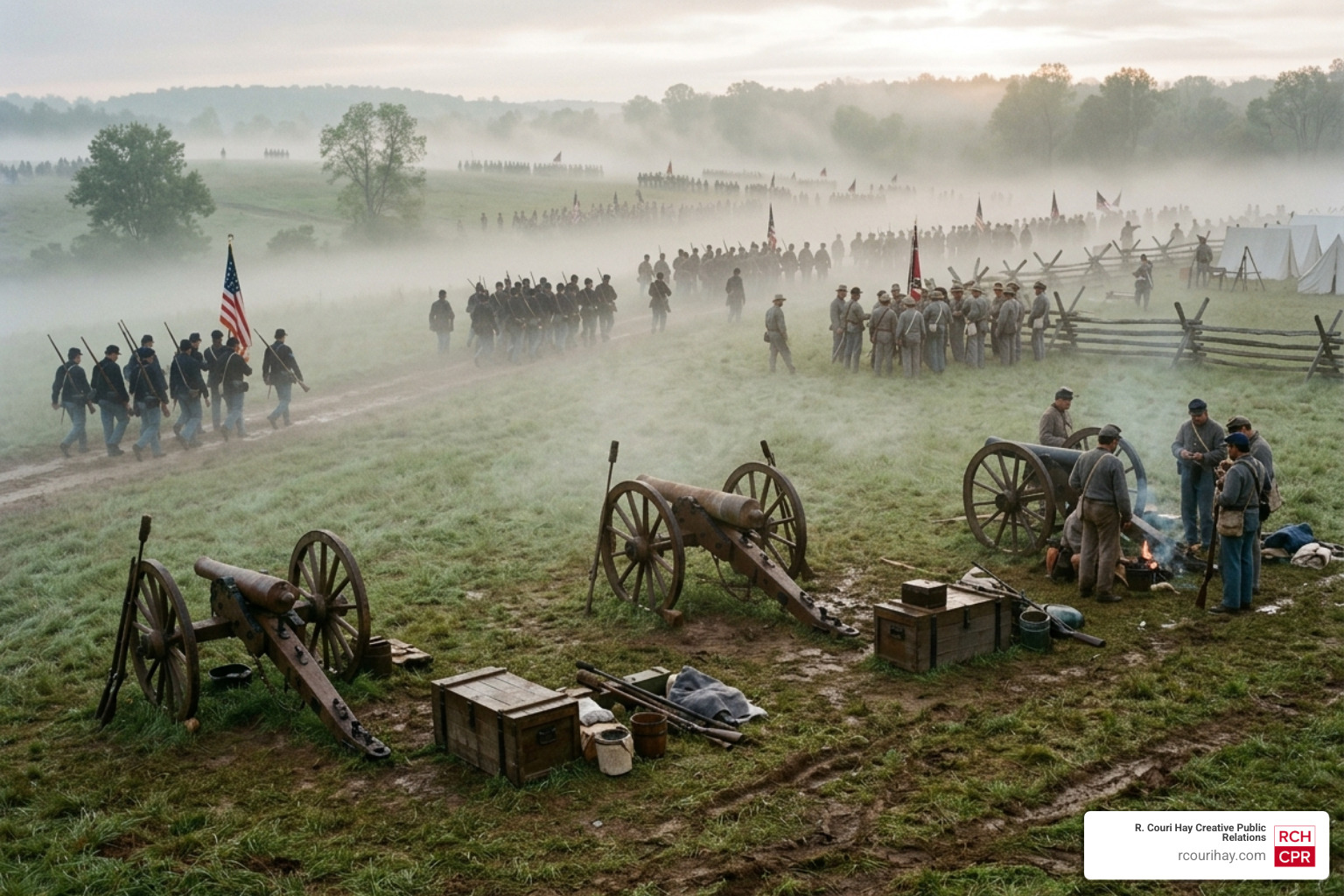
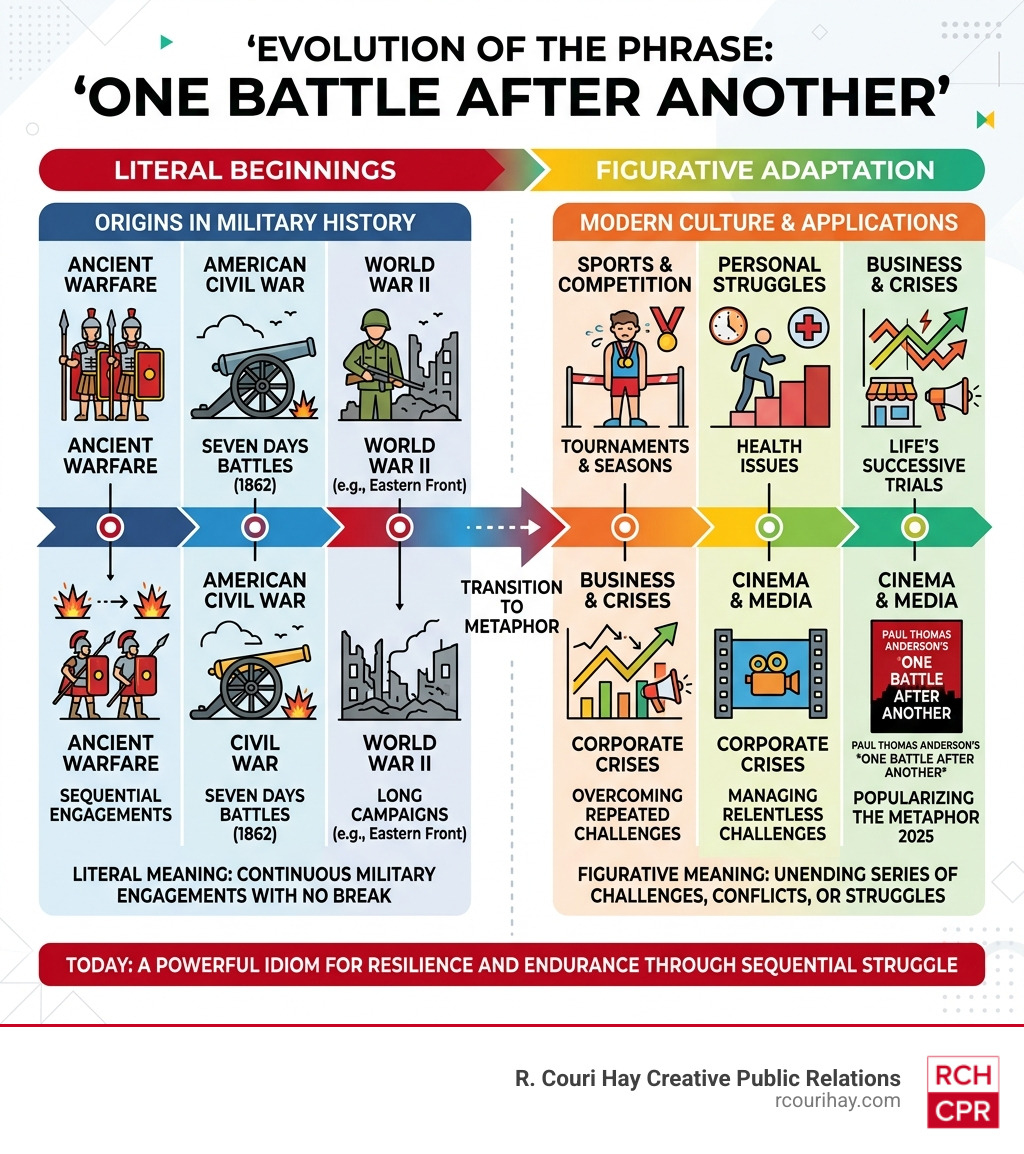
The phrase draws its power from military history. Think of the Seven Days Battles of 1862, where Robert E. Lee launched engagement after engagement over a single week to push Union forces back from Richmond. Or consider the Eastern Front of World War II, where soldiers endured the Siege of Leningrad for 872 days — nearly three years of unrelenting pressure.
But the phrase lives far beyond the battlefield. It shows up in cinema, music, corporate crisis management, and everyday conversation. Paul Thomas Anderson even named his acclaimed 2025 action-comedy-thriller One Battle After Another — a film that earned six Academy Awards and resonated precisely because the title phrase means something to everyone.
Whether you’re studying military strategy, analyzing a film, or navigating a high-stakes PR crisis, understanding this idiom unlocks a deeper appreciation for sequential struggle — and the resilience required to push through it.
Historical Conflicts: Facing One Battle After Another
When we look back at the most defining moments of human history, the phrase one battle after another isn’t just a figure of speech; it’s a literal description of life on the front lines. Nowhere is this more evident than in the List of World War II battles, a global conflict that demanded unprecedented tactical endurance from every side involved.
World War II was characterized by massive, multi-phased operations. Take the Siege of Leningrad (1941–1944), which lasted 872 days. For the civilians and soldiers trapped inside, it was a fight for survival against starvation and bombardment that felt like an infinite loop of suffering. Meanwhile, on the Eastern Front, the Battle of Stalingrad (1942–1943) became a turning point, but only after Axis forces suffered between 800,000 and 1.5 million casualties in a brutal, house-to-house grind.
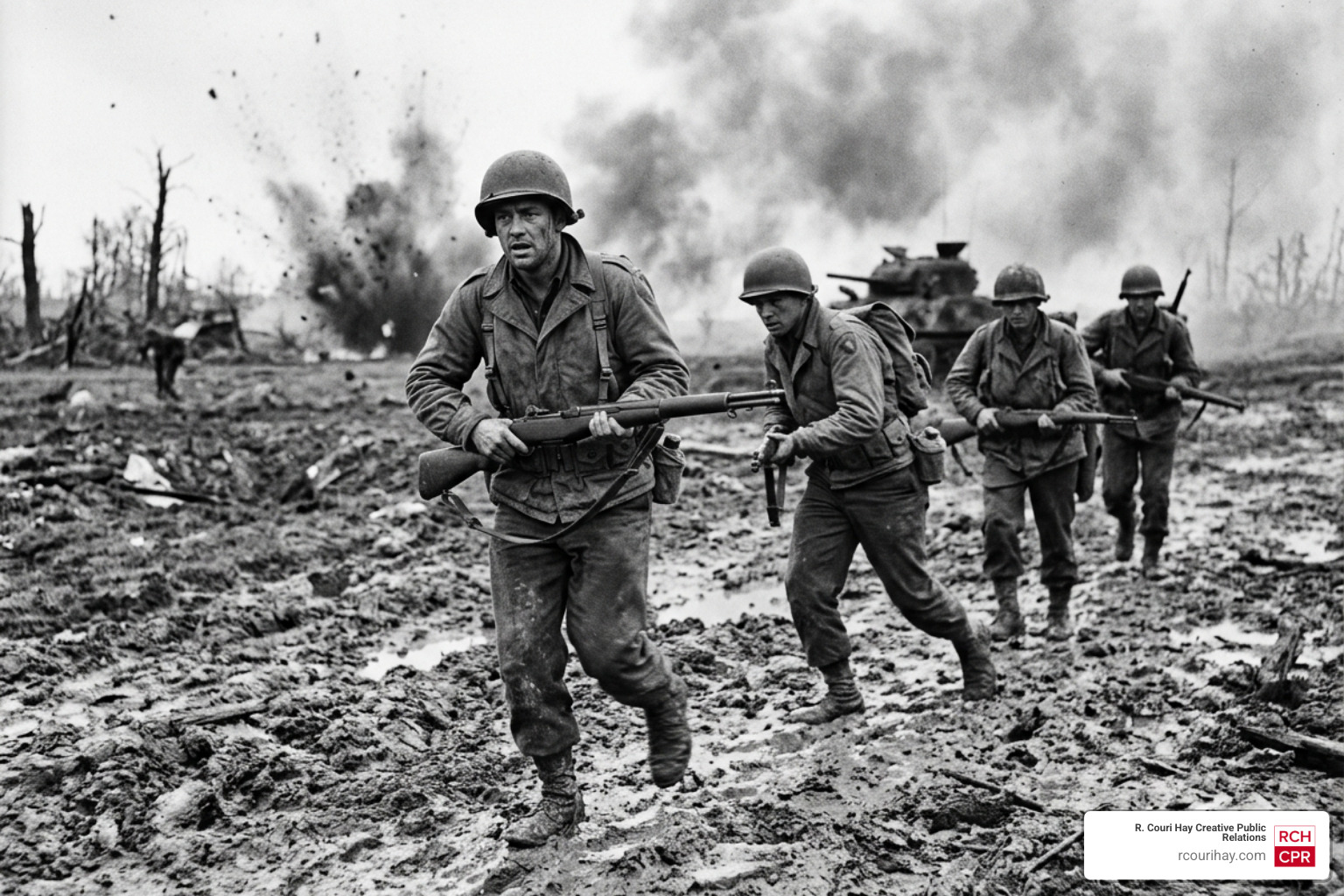
In the Pacific, the Guadalcanal Campaign lasted six months from August 1942 to February 1943. It was a grueling series of land, sea, and air engagements where U.S. forces lost approximately 7,100 men, while Japanese losses soared to 31,000. These weren’t isolated incidents; they were links in a chain of violence.
The Strategic Impact of Major WWII Engagements
| Battle / Campaign | Duration | Key Statistic | Strategic Impact |
|---|---|---|---|
| D-Day (Overlord) | June 6, 1944 | 156,000 Allied troops landed | Largest seaborne invasion; opened the Western Front. |
| Battle of the Bulge | Dec 1944 – Jan 1945 | 81,000 U.S. casualties | Final major German offensive on the Western Front. |
| Battle of the Coral Sea | May 1942 | First carrier-vs-carrier battle | Stopped Japanese expansion toward Port Moresby. |
| Siege of Leningrad | 872 Days | ~1 million civilian deaths | Symbol of Soviet resilience against Axis encirclement. |
Strategic context is everything. At the Battle of the Bulge, 410,000 German troops were thrown into a desperate offensive to split Allied lines. It was one battle after another in the freezing Ardennes forest, testing the very limits of American resolve.
The Seven Days Battles: A Week of One Battle After Another
In the summer of 1862, the Confederate capital of Richmond was under dire threat. The Union’s Army of the Potomac, led by the cautious George B. McClellan, was at the doorstep. What followed was a masterclass in psychological pressure orchestrated by Robert E. Lee.
The Seven Days Battles (June 25 – July 1, 1862) weren’t just a series of fights; they were a relentless barrage designed to unnerve the Union commander. Lee, commanding the Army of Northern Virginia, launched a sequence of attacks including Beaver Dam Creek, Gaines’s Mill, and Malvern Hill.
Interestingly, the Confederates actually suffered higher casualties (over 20,000) than the Union (16,000). However, Lee won the strategic victory. By maintaining the initiative and forcing one battle after another, he made McClellan believe he was facing a much larger force. McClellan, despite having 105,000 men, retreated in the face of Lee’s 92,000. This week-long “strategic debacle” for the Union transformed Lee into a legend and saved Richmond, proving that momentum can be more powerful than numbers.
Frederick the Great and the Masterpiece at Rossbach
Moving further back in time to the Seven Years’ War, we find Frederick the Great of Prussia facing seemingly impossible odds in 1757. Surrounded by enemies, Frederick utilized “interior lines”—the ability to move his troops quickly between different fronts—to intercept his foes.
At the Battle of Rossbach, Frederick faced an Allied army twice the size of his own. In a stunning 90-minute engagement, Prussian discipline and superior cavalry charges shattered the opposition. Frederick had marched his men 274 km in just 13 days to reach the field, a feat of endurance that allowed him to strike before the enemy was ready. This victory was a strategic masterpiece that prompted military reforms across Europe and cemented the Prussian army’s reputation for tactical brilliance even when outnumbered.
Cinematic and Cultural Interpretations
The concept of facing one battle after another resonates deeply in our art and culture because it mirrors the human condition. In music, U2’s iconic song “One” from the Achtung Baby album (which has amassed over 744 million Spotify streams as of May 2026) speaks to unity and the struggle to stay together despite the “battles” of a relationship.
Beyond music, the ONE Campaign, with its 1.6 million Facebook followers, uses the spirit of persistent “fighting” to advocate for economic opportunities and healthier lives in Africa. Their mission is a reminder that some of the most important battles are fought with policy and advocacy rather than weapons.
History also gives us moments of profound irony. In March 1945, in the city of Verdun—a place synonymous with the “one battle after another” meat-grinder of WWI—a Jewish Passover Seder was held for over 600 soldiers. In a poetic twist of fate, German prisoners of war were used to carry the chairs and food for the celebration. For those soldiers, celebrating freedom in a city that had seen so much death was a symbolic victory of survival over the Nazi regime.
Paul Thomas Anderson’s 2025 Film: One Battle After Another
In the cinematic landscape of May 2026, we are still talking about the massive impact of Paul Thomas Anderson’s latest epic. Titled One Battle After Another, the film is an action-comedy-thriller that became a juggernaut at the 98th Academy Awards, winning six Oscars including Best Picture and Best Director.
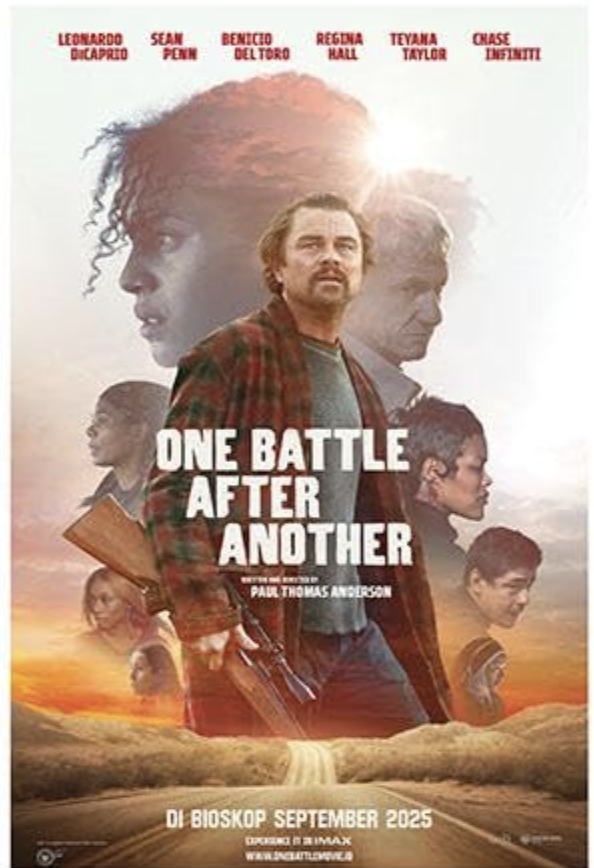
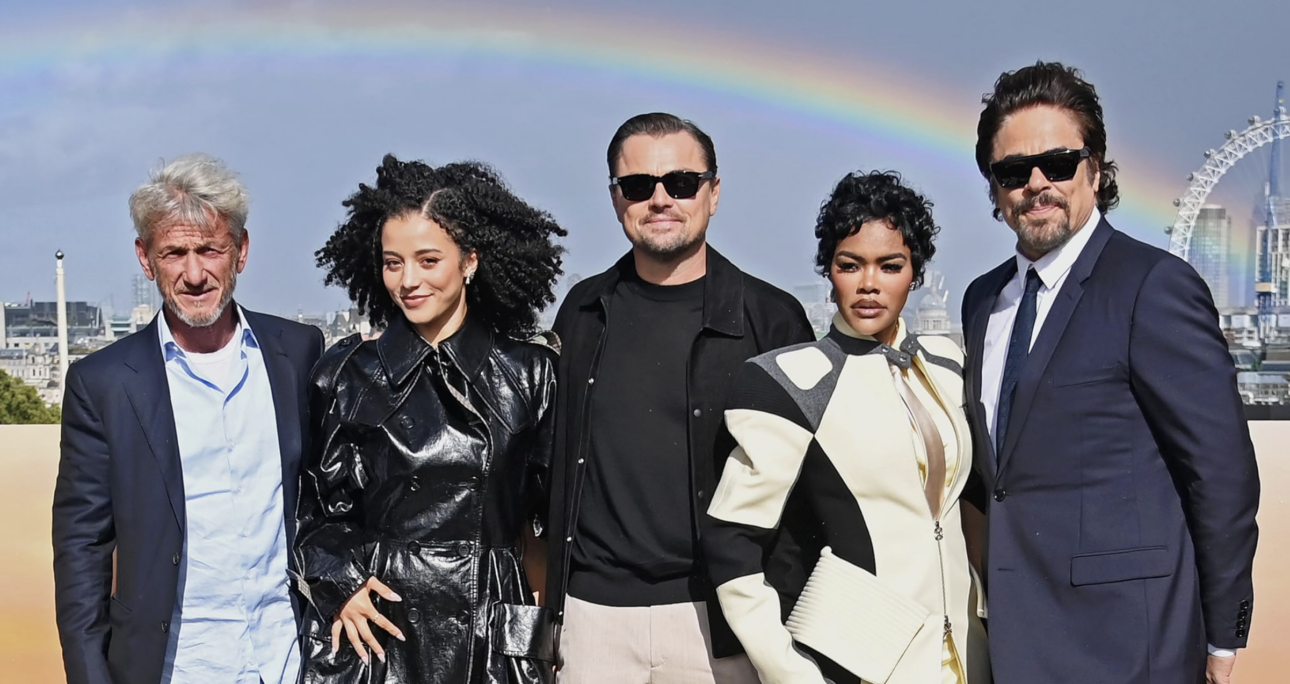
Loosely inspired by Thomas Pynchon’s novel Vineland, the film stars Leonardo DiCaprio, Sean Penn, Benicio Del Toro, Chase Infiniti, and Teyana Taylor. It is a technical marvel, shot on 1.5 million feet of film using the revived VistaVision format. This 1950s high-resolution technique was used for 75-80% of the movie, providing a “stylistic roughness” that perfectly captured the high-octane car chases and themes of the plot.
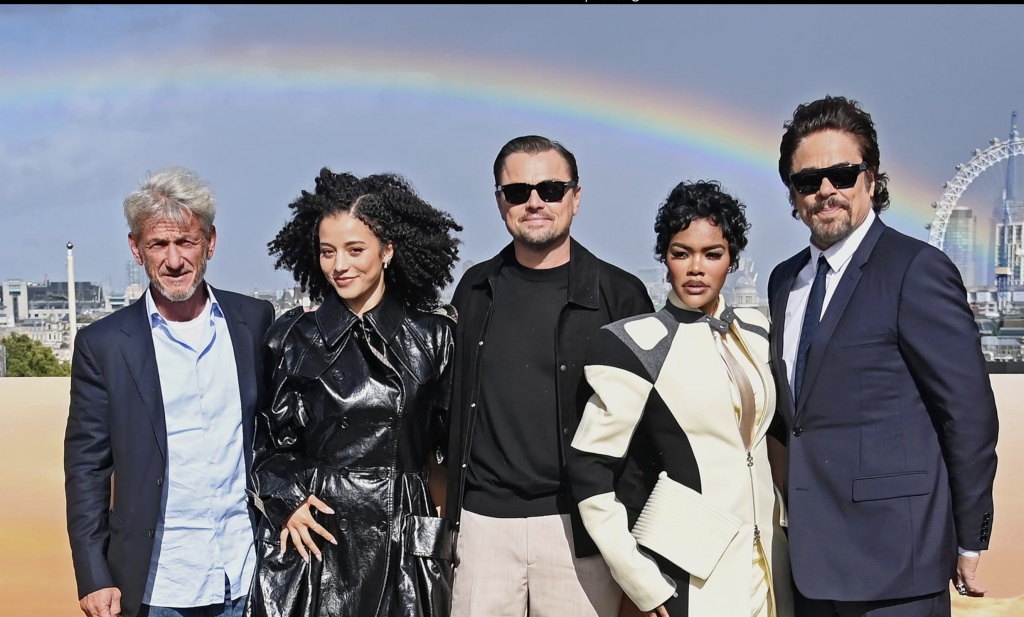
The film’s success highlights a 2025 cinema trend: audiences are craving stories about resilience. By blending 1970s-style grit with modern technical precision, Anderson created a narrative where the characters face a literal and metaphorical sequence of conflicts, mirroring the “always-on” challenges of the modern world.
The Linguistic Power of “One” in Modern Media
The word “one” itself is a linguistic powerhouse. According to Wiktionary, it developed its initial /w/ sound around the 14th century, and it has since evolved into various roles across global dialects. In Singlish and Manglish, “one” is used as a sentence-final particle to add emphasis. In formal writing, it serves as a generic pronoun, though modern speakers often find it a bit “affected.”
Culturally, the phrase “one battle after another” appears in everything from Shakespeare’s sonnets to modern film listings at The Prince Charles Cinema in London. It is a narrative structure we recognize instinctively—the hero who cannot catch a break, the repetitive conflict that tests their soul, and the eventual triumph (or tragedy) that follows.
Strategic Lessons from Famous Military Engagements
What can we learn from those who have faced one battle after another? Whether on a 19th-century battlefield or in a modern boardroom, the lessons remain remarkably consistent.
- The Power of Initiative: Robert E. Lee’s success in the Seven Days Battles came from his refusal to stop attacking. By keeping the pressure on, he forced his opponent into a reactive state.
- Reconnaissance is Non-Negotiable: J.E.B. Stuart’s famous “ride around McClellan” provided the intelligence Lee needed to strike effectively. Without clear data, you are fighting in the dark.
- Utilize Defensive Terrain: At Malvern Hill, Union forces used the high ground to inflict massive casualties on the attacking Confederates. Knowing when to stand your ground is as important as knowing when to charge.
- Communication and Coordination: Many of the failures in historical battles (like Stonewall Jackson’s uncharacteristic delays during the Peninsula Campaign) were due to a lack of clear communication. In complex operations, if the left hand doesn’t know what the right is doing, the results are often disastrous.
Managing Reputation: The Modern PR Battle
In our work at R. Couri Hay Creative Public Relations, we often see the idiom one battle after another applied to reputation management. In the “always-on” digital world, a single mistake can trigger a “cottage industry of criticism” that requires a dedicated, long-term strategy to overcome.
We live in an era of “trust inequality.” Data from trust barometers shows a widening “mass-class divide,” where the wealthy and educated have vastly different trust levels in institutions than the general population. The 2008 financial crisis killed the “century-old dream” of upward mobility for many, leading to a leadership vacuum that social media has only polarized further.
When a brand faces a “material breach of trust,” the recovery is a “battle for inches.” There is no “spin” that can fix a genuine crisis; there is only transformative action. This involves:
- Radical Transparency: Owning the mistake immediately and completely.
- Marketplace Remedies: Taking tangible steps to ensure the error never happens again (e.g., an Italian food company creating a diversity board after a PR backlash).
- Third-Party Validation: Using independent experts to verify that changes have been made.
- Sustained Effort: Recognizing that an apology is rarely accepted the first time. It takes a “recovery campaign” to shift the narrative back to positive territory.
Frequently Asked Questions about “One Battle After Another”
What is the origin of the idiom “one battle after another”?
The idiom has its roots in military history, describing campaigns where engagements were so frequent that they blurred together. Linguistically, it evolved alongside the word “one” to emphasize a relentless, countable sequence of hardships.
Who directed the 2025 movie “One Battle After Another”?
The film was written, directed, and produced by the legendary Paul Thomas Anderson. It is widely considered the most ambitious and expensive project of his career, featuring a star-studded cast including Sean Penn and Benicio del Toro.
Which historical war is most associated with the phrase “one battle after another”?
While applicable to many, the phrase is most frequently associated with World War II due to the sheer scale and frequency of its engagements, and the American Civil War, specifically the intense week of the Seven Days Battles in 1862.
Conclusion
Whether we are looking at the tactical brilliance of Frederick the Great or the cinematic mastery of Paul Thomas Anderson, the phrase one battle after another serves as a testament to human endurance. In high-stakes public relations, we understand that resilience isn’t just about winning a single fight—it’s about the ability to navigate a sequence of challenges with grace, strategy, and integrity.
At R. Couri Hay Creative Public Relations, we specialize in helping our clients manage their most important battles, from luxury lifestyle stories to complex reputation recovery. Based in New York City with presence in Southampton, Los Angeles, Palm Beach, Aspen, London, and Paris, we bring a global perspective to every challenge.
Stay updated with the latest lifestyle and PR news and learn how to master your own modern-day battles with our expert guidance.