
For more than 140 years, Kroger has stood as one of the most recognizable names in American grocery retail. Founded in 1883 in Cincinnati, Ohio, the company has grown from a single tea and grocery store into the largest pure-play supermarket operator in the United States. In 2026, Kroger continues to operate roughly 2,700 stores across 35 states and the District of Columbia under a family of regional banners, employs more than 400,000 associates, and generates annual revenue in the range of $147–149 billion.
This article examines the history of Kroger, its current business model, private-brand strength, recent strategic shifts—including leadership changes and the 2026 Giant Eagle acquisition—and what the company looks like in the present year.
A Brief History of Kroger
Bernard H. “Barney” Kroger opened the Great Western Tea Company in 1883 with $372 of his own savings. Early on, the business distinguished itself by offering a wider assortment of goods and maintaining tighter control over quality and supply. Over the following decades, it evolved into the Kroger Grocery and Baking Company and eventually the modern company we know today.
Key expansion milestones included the 1983 merger with Dillon Companies, which brought strong regional banners such as King Soopers and Fry’s into the portfolio, and the transformative 1999 acquisition of Fred Meyer. That deal significantly broadened the company’s geographic reach and introduced larger multi-department store formats. Through a combination of organic growth and carefully chosen acquisitions, the company built a national presence while preserving local banner identities that shoppers still recognize and trust.
Kroger’s Store Network and Operations in 2026
As of early 2026, Kroger operated approximately 2,697 supermarkets. The majority of these locations include pharmacies (around 2,250), and a substantial number also feature fuel centers. The company maintains several store formats:
- Traditional combination food-and-drug stores that form the core of the business
- Larger multi-department and marketplace stores offering apparel, home goods, electronics, and other general merchandise
- Value-oriented warehouse formats designed for price-sensitive shoppers
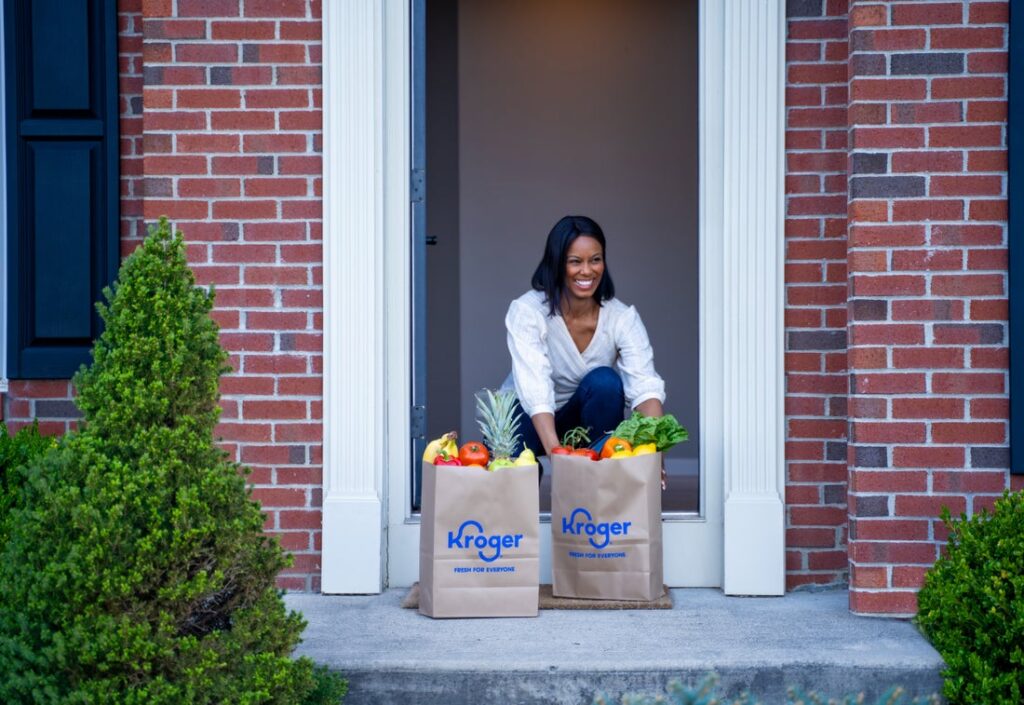
Fuel and pharmacy services play important roles beyond simple add-ons. They increase visit frequency, support the loyalty program, and contribute meaningfully to overall profitability. Digital options—online ordering with in-store pickup or home delivery—are available across nearly the entire network, giving customers flexibility in how they shop.
In 2026 the company continues to refine its physical footprint. Plans announced in prior years to close underperforming stores (approximately 60 locations) are progressing, while new store openings and expansions are accelerating in higher-growth markets. This dual approach of pruning weaker sites and investing in stronger ones reflects a focus on long-term productivity rather than pure square-footage growth.
The Strength of Private Brands and Loyalty
One of Kroger’s most durable competitive advantages is its private-label portfolio, marketed collectively as “Our Brands.” These products generate more than $30 billion in annual sales and represent a significant share of total grocery revenue. The portfolio is structured across price and quality tiers:
- Core Kroger brand items for everyday value
- Simple Truth for natural and organic products
- Private Selection for premium and specialty offerings
- Additional regional and category-specific labels
Private-label products allow the company to offer competitive pricing while protecting margins and giving shoppers exclusive options they cannot find at every competitor. In an environment where many households remain price-conscious, these brands have continued to gain share.
Loyalty programs and data-driven personalization further strengthen customer relationships. Fuel rewards, digital coupons, and membership options encourage more frequent trips and higher basket sizes. The company also generates higher-margin revenue from advertising and media services that leverage customer insights and store traffic.
Leadership Transition and Strategic Reset in 2026
The mid-2020s brought significant change for Kroger. The proposed $24.6 billion merger with Albertsons, announced in 2022, was blocked by federal and state courts in late 2024 on antitrust grounds. The failed deal triggered legal disputes between the two companies and forced a strategic recalibration.
Leadership also shifted. After a period of interim leadership, Greg Foran—a former Walmart executive with extensive retail experience—was named CEO in February 2026. Under the new leadership team, the company has emphasized operational discipline, private-brand growth, store optimization, and more selective expansion.
In July 2026, Kroger announced its first major acquisition under the new CEO: a $1.65 billion agreement to purchase regional supermarket chain Giant Eagle. The deal includes approximately $1.25 billion in cash and the assumption of about $400 million in liabilities. Giant Eagle operates roughly 197 supermarkets and 11 standalone pharmacies across northern Ohio, western Pennsylvania, West Virginia, Maryland, and Indiana, generating about $9 billion in annual sales. The transaction is expected to close in 2027, subject to regulatory approval, and is viewed as a more targeted, regionally focused growth move compared with the earlier Albertsons attempt.
Competition and the Broader Grocery Landscape
Kroger operates in a highly competitive environment that includes national discounters, club stores, other traditional supermarket chains, and a growing number of online and specialty players. Success depends on a combination of competitive pricing, strong fresh and prepared-food execution, convenient digital options, and the ability to build lasting customer loyalty through private brands and rewards.
The company’s scale provides advantages in procurement, private-label development, and data capabilities. At the same time, the thin margins typical of the grocery industry require constant attention to costs, inventory management, and store-level performance. In 2026, Kroger continues to balance everyday value with investments in the shopping experience, including improvements in produce, prepared foods, and in-stock reliability.
Looking Ahead
As 2026 unfolds, Kroger is focused on executing a clearer post-Albertsons strategy: optimizing the existing store base, growing higher-margin private-label and alternative-profit businesses, strengthening digital and loyalty capabilities, and pursuing measured acquisitions such as the Giant Eagle deal. The appointment of a new CEO with deep retail operational experience signals an emphasis on disciplined execution.
For shoppers, Kroger remains a primary destination for groceries, pharmacy needs, and fuel in many communities. For investors and industry observers, the company represents a large-scale test of whether a traditional supermarket operator can continue to adapt in an era of intense competition, changing consumer habits, and regulatory scrutiny of industry consolidation.
Conclusion
From its founding in 1883 as a single Cincinnati store to its position in 2026 as the largest pure-play supermarket chain in the United States, Kroger has demonstrated remarkable longevity and adaptability. The company now operates thousands of stores under familiar regional banners, generates nearly $150 billion in annual sales, and continues to invest in private brands, digital convenience, and selective growth. While the blocked Albertsons merger marked a significant setback, the leadership transition and the 2026 Giant Eagle acquisition illustrate a willingness to adjust course and pursue more achievable expansion opportunities.
Whether you shop at a local Kroger, Ralphs, Harris Teeter, Fred Meyer, or another banner in the family, the company remains deeply embedded in the everyday routines of millions of American households. Its ability to balance value, quality, convenience, and operational discipline will determine how successfully it navigates the remainder of the decade.