

SpaceX has become the dominant force in modern spaceflight. From its early days developing the Falcon 1 to its current leadership in orbital launches, satellite broadband, and next-generation heavy-lift systems, the company continues to reshape access to space. As of August 2026, following its public listing, strong financial results, and steady progress on the Starship program, SpaceX sits at a critical turning point. This article examines the company’s history, current operations, recent milestones, and long-term ambitions.
Early Years and the Path to Orbit
Elon Musk founded the company in 2002 with the dual aims of lowering the cost of reaching space and enabling multiplanetary life. Early work centered on the Falcon 1 rocket. After three failed launches that brought the firm close to collapse, the fourth flight in September 2008 successfully reached orbit. This achievement marked the first time a privately developed liquid-fueled rocket had done so.
NASA contracts under the Commercial Orbital Transportation Services program followed. The Falcon 9 rocket and Dragon spacecraft were developed, culminating in the first commercial docking with the International Space Station in 2012. These successes established the company as a reliable partner capable of delivering cargo while traditional contractors operated at higher cost and a slower pace.
The Reusability Breakthrough
The defining technical advance came with the recovery and reuse of orbital-class boosters. On December 21, 2015, a Falcon 9 first stage landed vertically after placing satellites into orbit, the first successful recovery of its kind. Landings on autonomous drone ships and the ability to refly the same boosters many times transformed launch economics.
By 2026, individual Falcon 9 boosters regularly complete 20, 30, or more missions. This high rate of reuse, paired with frequent launches, has made the company the global leader in orbital launch services by both flight count and mass delivered to orbit. Falcon Heavy extended the same approach to heavier payloads and demonstrated simultaneous recovery of multiple boosters.
Starlink as a Major Revenue Driver
While rockets attract the most attention, the Starlink broadband constellation has become a central source of revenue. Large-scale deployments began in 2019 and have produced one of the largest satellite networks ever built. Regular Falcon 9 missions placing 24 or more satellites into low Earth orbit have steadily expanded coverage and capacity.
In 2026 the company is introducing V3 Starlink satellites designed for substantially higher throughput, with reported improvements approaching ten times the capacity of earlier versions. These satellites support denser service, faster speeds, and direct-to-cell connectivity. Income from the network helps finance the more expensive Starship development program while creating a cycle in which more launches expand the constellation and generate additional revenue.
Starship Development and Recent Test Flights
Starship is the vehicle intended to fulfill the original multiplanetary vision. The system pairs a Super Heavy booster with a large upper stage designed for full and rapid reusability. The objective is to cut the cost of reaching orbit dramatically, support lunar missions, enable point-to-point Earth transport, and eventually carry crews and cargo to Mars.
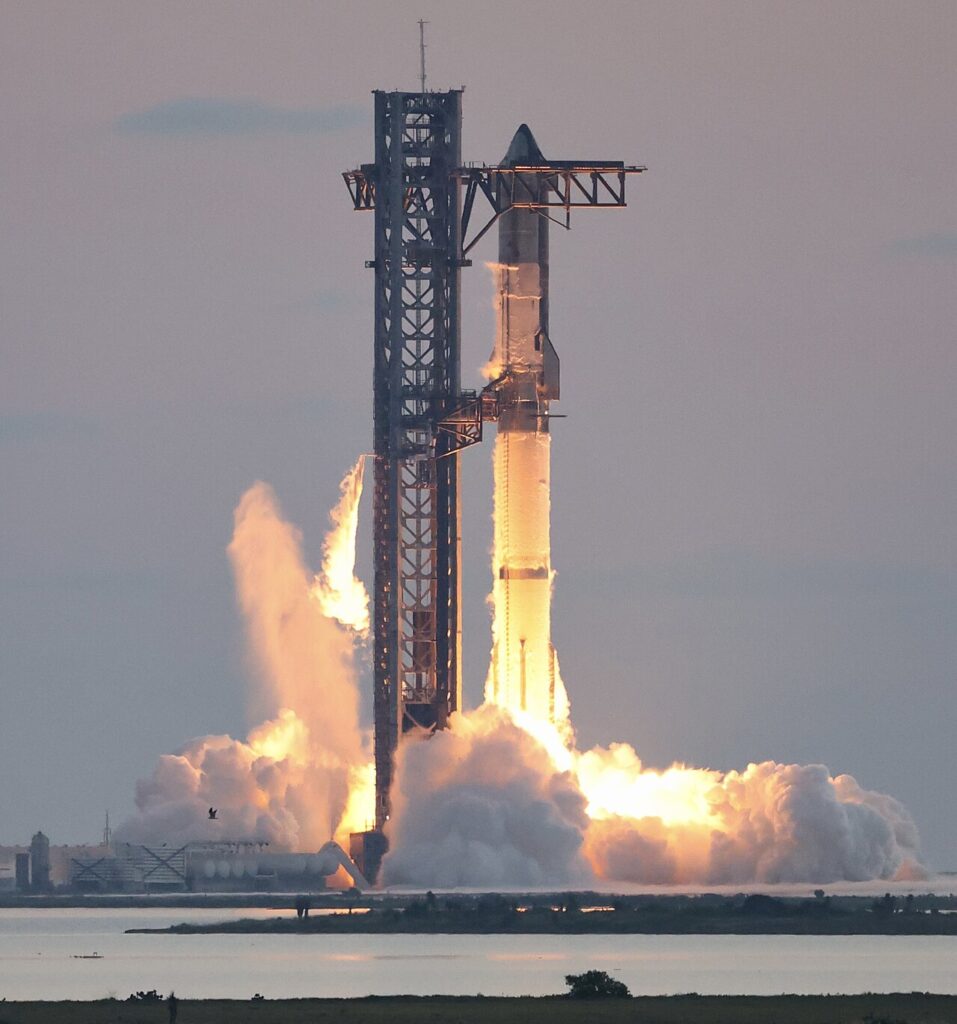
Testing has followed an iterative path of rapid flights and incremental learning. After earlier missions that included structural failures and explosions, progress accelerated in 2026. Flight 13 on July 24 lifted off successfully from Starbase in Texas, deployed 20 V3 Starlink satellites on a suborbital trajectory, demonstrated key engine operations, and achieved a soft ocean splashdown of the upper stage with promising heat-shield results.
As of early August 2026 the company is preparing for Flight 14, tentatively planned for the end of the month. The mission is expected to place the first operational V3 Starlink satellites into true orbit and, if regulatory approval is secured, attempt the first catch of the upper stage using the launch tower’s mechanical arms. Success would represent a major advance toward routine reusability. Leadership has projected that flight rates could eventually reach one or more launches per day.
Public Listing and Financial Results
In June 2026 the company completed its initial public offering and began trading under the ticker SPCX. The listing reflected investor confidence in both the established Falcon and Starlink businesses and the longer-term potential of Starship, lunar landers, Mars transportation, and concepts such as orbital data centers.
In its first earnings report as a public company in early August 2026, second-quarter revenue reached $7.8 billion, an increase of 92 percent year-over-year, while the net loss narrowed to $541 million. The figures highlighted solid performance in launch services and connectivity even as research and development spending on Starship remained high. Capital expenditures stayed elevated as infrastructure expanded to support higher flight rates.
Current Operations and Industry Position
The company maintains an unmatched launch cadence. Falcon 9 continues to fly multiple times each week from Florida and California, supporting Starlink deployments, government missions, and commercial customers. Recent flights have included additional Starlink batches and payloads for partners such as AST SpaceMobile. Multi-launch awards from the U.S. Space Force further illustrate reliability and capacity.
This tempo has made the firm responsible for a large share of global orbital mass delivered each year. Competitors have struggled to match the combination of price, frequency, and proven reuse that the company delivers.
Ongoing Challenges
Technical and regulatory hurdles remain. Heat-shield performance, engine reliability during recovery, and tower-catch operations still require refinement. Environmental reviews, range safety rules, and coordination with regulators affect schedules. As a newly public company, it also faces greater scrutiny of valuation, capital allocation, and governance.
The historical pattern of iterative improvement, turning early Falcon 1 failures into today’s high-reliability Falcon 9 fleet and steadily advancing Starship through successive tests, suggests these issues will continue to be addressed.
Wider Effects on the Space Sector
The company’s rise has accelerated commercial space activity overall. Lower launch costs have enabled new satellite constellations, scientific missions, and national-security architectures. Reliance on Crew Dragon for International Space Station access restored U.S. human spaceflight capability after the Space Shuttle era ended. Starlink has brought broadband to regions previously poorly served by terrestrial networks.
Looking further ahead, Starship is central to NASA’s Artemis lunar lander plans and to the company’s own vision of crewed Mars missions. Concepts involving large-scale orbital manufacturing, space-based solar power, and orbital computing appear regularly in long-term discussions.
Continued Public Interest
Interest remains high because of a mix of concrete results and ambitious goals. Live launch broadcasts, recovery attempts, and open communication about both successes and setbacks keep the company visible. The prospect of routine orbital access followed by lunar and interplanetary flight continues to draw attention.
Search activity around launch schedules, Starship updates, Starlink expansion, and financial performance reflects genuine curiosity about timelines, capabilities, and the firm’s role in the broader space economy.
The Road Ahead
In 2026, the company is no longer an outsider challenging established players. It is the leading launch provider, the operator of a major global communications network, and the developer of the most powerful rocket system currently in testing. Proven Falcon 9 operations, expanding Starlink service, advancing Starship flights, and public-market resources together position it for the next stage of growth.
Measured by flight rate, mass-to-orbit, satellite deployments, or the scale of its longer-term aims, the company continues to redefine what is possible in spaceflight. As Flight 14 approaches and the first operational V3 Starlink satellites reach orbit, the months ahead will show further evidence of progress already made and of the distance still to be covered.
Understanding this trajectory remains essential for anyone following the commercial space industry. Over two decades of persistent engineering, vertical integration, and calculated risk-taking have delivered strong results. The next chapter, centered on full reusability and interplanetary capability, is already in motion.